
Why is My Dog Afraid of Everything?
I wish there was an easy answer to this month’s topic, but as with all things behavior, it is complicated! Behavior never happens in a bubble of singular events.
This month though, I want to focus on common themes in cases with fear that presents as more intense than usual, and that is the effects of overprotective caregiving styles on development of neophobia. We know this as “helicopter parenting” in the human world.

Before we begin, this blog isn’t a judgment or admonishment of doggy parents that have a difficult time letting go. I do this to make a difference within households and I find these types of cases extremely rewarding - albeit challenging.
My goal is to always improve the quality of life for all parties. I have a deep recognition that there are many reasons that pet parents might feel anxious and yearn for a sense of control. All I ever want to do is educate with compassion and empathy - and a little humor never hurts. So, let’s get to it..

Confidence and Autonomy in Dogs
What does encouragement of “normal” doggy behavior look like and how can we shape dogs to be confident from a young age?
Dogs that have varied diets gain exposure to new scents, tastes, and textures. Barring medical limitations, does your dog have access to explore savory foods?
Dogs that have access to the household and aren’t confined by gates have autonomy over where they can rest and decompress when they’re stressed out or tired, as well as access to different windows to enjoy the world. Barring safety issues, is your dog allowed natural exploration of their home environment?
Dogs that are walked on different routes or outside their neighborhood have exposure to visual and olfactory novelty as well as different sensations under their feet. Does your dog have experience outside of your immediate neighborhood and are they routinely walked on non-paved surfaces, like grass?
Dogs that have access to new toys benefit from exposure to differently-shaped, novel items in the environment and the noises they might make. Does your dog regularly get new toys to explore and play with?
Dogs that rehearse behaviors that they enjoy such as zooming, digging, chewing, and shredding are engaged in normal doggy behaviors and healthy coping outlets. Does your dog get opportunities throughout the day to zoom around and sniff, chew, shred, dig, or whatever might please them?
Dogs that are engaged in training or puzzles have the ability to problem solve and work logically through things that are slightly challenging, as well as having natural foraging needs met. Do you engage your dog in basic training as well as offering meal times out of puzzles?
Dogs that are allowed access to explore their yards have autonomy over where they can relieve themselves, which is a basic need. They also have exposure to novel scents like wildlife that pass through and exposure to different sensations under their feet. Barring lack of fencing, does your dog have access to their entire yard?
Dogs that navigate common environmental obstacles (like stairs) have exposure to using their entire bodies to navigate and problem solve through daily life. Barring medical necessity, is your dog allowed to navigate their environment unassisted?
Dogs that are allowed to sniff on walks or explore the world with their mouths are afforded natural coping mechanisms that a dog might use to calm down (sniffing is like a breathing exercise) and encourages species-appropriate exploratory behaviors. Does your dog sniff on walks and are they allowed to pick up things like leaves and explore them (provided they aren’t ingesting dangerous items)?
Deficits in several or close to all of these can lend themselves to issues with confidence. Once these are laid out, it’s easier to see how dogs begin struggling to “dog” normally. When given choice and autonomy from a young age, dogs may not struggle with fear of “newness” as they age.
One of the first things we take a look at in our consults are where these deficits are and how we can address them to begin unlocking natural curiosity in the dog again. Giving back freedoms requires a careful process and can be hard on the dog. They may be equally hard on the human, too.
Who is More Likely to “Helicopter” Their Dogs?
If you don’t have a fearful dog and you’re just here to learn, you might be wondering why someone may be apprehensive of some of these.
First, I’d like to explore common reasons why people may “helicopter” their dogs:
Similar to humans who have experienced tragedy with children and become concerned, sometimes an event occurred such as the dog being VERY sick at a young age. This sort of thing is scary and causes deep trauma to the human.
A previous dog experienced medical trauma or struggled their entire life with illness and that caused emotional and/or financial hardship on the human. I call these the “Ghosts of Dogs Past” and they haunt these humans in ways they don't realize.
Personal stress can cause anxiety. It is always a privilege to be confided in regarding those issues as it helps me calibrate training plans. The moral of the story is that you never know what people are going through privately.
The above can lead to a feeling of chaos and unpredictability. In an attempt to reel in those worries, routines and rules are set in place.
More anecdotally, certain professions and qualities in humans make them more prone to helicopter-caregiving styles. These people are usually very gifted in their fields and exceptional at observing behavior. People who are natural caregivers and good at taking care of others may suffer from the issues above, more readily.
Thus, I see this more in women. Basically, these types of people are DEEPLY empathetic and caring. Their love for their dogs is nearly unmatched if you really take a moment and listen, as I believe the very concept of helicoptering is borne out of compassion.
People that have only used “traditional” training methods in the past may struggle to let go of certain ideals. Traditional training relies heavily on cuing the dog into behaviors or “telling the dog what to do” all the time (commands). In other words, a heavy reliance on obedience and less focus on self-regulation and helping the dog make good choices. I’m sorry to say this, but men may have a more difficult time with this one in my personal experience.
Socialization in Dogs
What happens when a dog’s world is kept “very small”?
Socialization may be critically impacted by lack of exposure to common occurrences. Later in life when dogs are presented with challenging experiences when their brain is fully-developed, they lack prior learning experience to fall back on and they don’t know how to respond. Critical socialization windows are between 3 weeks to 16 weeks old. The brain is at its most plastic during this time and is the most resilient.

Most people are familiar with the concept of neophobia as it pertains to puppy mill dogs. These dogs spent their entire lives in serious confinement and without human interaction. The experiences they did have are often unpleasant. These dogs are often afraid of all types of noises, wildlife, people, new smells, and different sensations under their feet such as grass, mud, sand, gravel, and even sometimes hardwood flooring and tile. These dogs are also serious flight risks and escape artists. They’ve lived their lives fighting to survive and their need for self-preservation is ingrained in their psyche.
Proper socialization focuses on early exposure to all of these things in a controlled and positive manner to avoid dogs becoming a lesser version of this very extreme example.
While some neophobic dogs may not have necessarily been brought up in a cage, all dogs are still captive animals. We tell them when they can eat, what they can eat, when they can take a walk or use the yard, when they can get medical care (and the quality of it is out of their control), what their enrichment will be, what methods of training are used on them, when and where they can sleep, and the list goes on. For dogs that live very sheltered lives, these affordances get more and more narrow and fear can creep in from lack of proper exposure.
With time, these fearful responses to stimuli (like fleeing, ducking/crouching, flinching, or even circling/pacing) become “well-practiced” and I call these “default responses”. When they have encountered something concerning, these behaviors have worked well all this time and kept them alive, so they must be working, right? In a dog’s mind the answer is, yes!
These are “fight or flight” responses and they serve the purpose of survival. In that sense, they are self-reinforcing on a deeply biological level. The behaviors get stronger until the dog is no longer functioning “like a normal dog” in daily life. These behaviors can then be very difficult to modify the longer they go on.
Common Mistakes When Training Fearful Dogs
So, what are we suppose to do about this? Well, the simple answer is careful exposure to novelty - but the approach is anything but simple. There are many pitfalls and missteps to this by well-meaning people who just want to help because they love their dogs.
Firstly, we want to avoid exposure to triggers too intensely and not immerse the dog in situations they cannot escape from. If you’ve ever taken your dog into an environment that they struggled with the intention that they will “get use to it” the more they are exposed, you are not alone. This is a common approach many people try and it is called habituation in dog training, if it works.

If it isn’t working, you might be questioning why progress isn’t happening or feel that it may be getting worse. What happens when an experience is too intense is that it can be accidentally flooding instead and dogs can enter a state of fight or flight to try to escape, so they can cope.
It is important to realize that the fight or flight response is an automatic, uncontrollable response for survival and so, the brain is not in a logical state. Attempting to habituate a dog under these conditions may have the opposite effect. They may not be capable of learning - or at least not the lessons we hope they are learning.

Perhaps you are afraid of spiders? Or maybe heights? If you were in a situation where you were faced with your biggest fear at an overwhelming intensity and then I tried to teach you math, you’d probably have a hard time. I use math examples because I’m terrible at math, but even if you’re excellent at math, you will have difficulties recalling your knowledge under extreme fear.
Habituation without counter conditioning can lead to deeper fear because the dog knows it cannot escape. They are usually on a leash when it happens or being carried. In some puppy classes, they still practice passing puppies around in a circle. For already fearful pups, this can be devastating emotionally.

I liken this to a child that is presented with a scary person that is attempting to invade their space, no matter how innocently. Forcing a child to hug someone they are afraid of doesn’t change the emotional response and oftentimes the closer the scary person gets, the more flooded they become with fear. This can lead to full blown fight or flight responses. Dogs can experience this too with well-meaning people during greetings that are looking at them, talking to them, and sometimes pressuring them to come say hi.
Take a look at the chart below on the 4 F’s of Fear. I’ve found this to be an extremely useful handout in my consults in helping people understand how dogs behave when they’re attempting to cope.
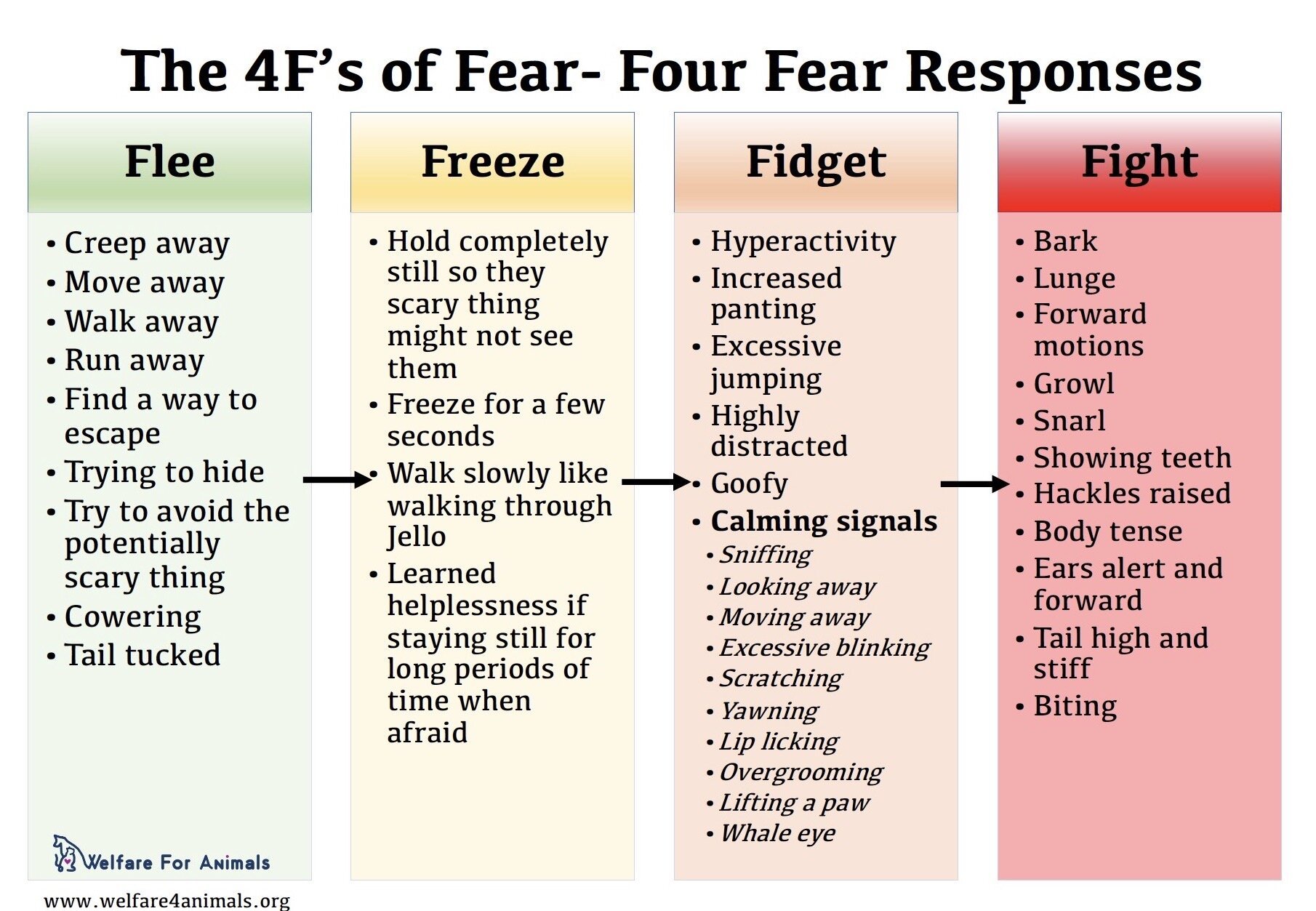
The categories of freeze and fidget may be less recognizable to you. They have the appearance of being “less intense” than classical fight or flight, but they are actually housed within the same area of the brain (the amygdala). In fact, I deal with a GREAT deal of dogs who “stress UP” instead of down - dogs with repetitive jumping during greetings with strangers, dogs that zoom around and act playful, etc.
Most people look at dogs acting like this and think they’re just hyper. These dogs are struggling to regulate. The behaviors are often over-the-top and difficult to interrupt verbally or with training. They can be equally as difficult to modify as fearful ones because they are 2 sides of a similar coin.
Both of these categories may snowball into more recognizable fight or flight responses as the dog reaches social maturity and doesn’t know how to get the space they need. But I digress, I wanted to take a moment and explain that photo a little more.
How to Help a Fearful Dog
If these are looking familiar, you might be feeling helpless and wondering how you can help your dog RIGHT NOW.
When considering how to intervene for these dogs and how to provide proper and positive exposure, we can think of fear and counter conditioning like mathematics (haha, I really hate math).
The first thing we teach a child to do is count something like beans or fingers, then we teach basic addition and subtraction, then higher concepts. When training with stressors, always ask yourself, “Is my dog counting beans or doing long division right now?” and “is my dog practiced enough on coping strategies to conquer this?” If the answer is no, avoid those situations for right now.
This might look something like:
Discontinuing walks if they are only allowing your dog to stay in a heightened state of stress.
-OR- if your dog is OK in your neighborhood or quiet forest preserve, stick with what they can tolerate and do not attempt to walk on busy sidewalks or roads.
Discontinue taking your dog into busy stores.
Discontinue attempting car rides for no reason if they appear to be frantic (obviously dogs need to go to the vet!).
Discontinue greetings with visitors in your home and opt for confinement in another room - sometimes they are HAPPIER with this!
Discontinue attempting to introduce your dog to any stranger that approaches on the street or in public.
Your dog needs to learn how to “count beans” first - and that might mean breaking down environmental exposure into very, very small increments when they’re ready, in order to apply counter conditioning and desensitization training.

You have MY full permission to apply damage control and reduce exposure to things that elicit deep fear - especially if it is also causing YOU distress. In fact, the first step in my plans is eliminating daily stress wherever we can so that we have a more relaxed dog that is ready to learn.
In the meantime, this might mean this dog's world gets even smaller before it gets bigger again. It is going to feel counter-productive at first, but I promise it has a purpose - that is to reduce daily stress and the hormones that accompany it to get your dog out of their “funk”.
Controlling environmental stress through new management and processes is NOT a failure. Remember that the goal is to open that world back up, and even wider than before, if we can.
Who Can Assist You With Your Fearful Dog
It is STRONGLY recommended to tackle this alongside professionals, so reduce exposure and consider the following steps:
PLEASE call in a professional behavior modification specialist that understands the nuances of fear and stays up-to-date on certifications and coursework.
PLEASE check for medical issues as any pain or discomfort in the body will ALSO push the brain into fight or flight as a means to avoid that outcome in the future.
PLEASE discuss formal intervention with a veterinarian regarding clinical signs of anxiety. If the fear seems intense, automatic, and outside of the norm, it can be extremely difficult to find windows of calm to train through - and very fatiguing on you, the caregiver.
PLEASE consider seeing a veterinary behaviorist. These veterinarians are specialists in behavior intervention and pursue higher learning in these concepts. They can ensure the very best intervention is applied. All of them work collaboratively with trainers and will be able to guide you towards humane solutions to deal with this, once your dog is feeling some relief.
In the meantime, if you want to learn more about stress, trigger stacking, body language, decompression, and natural calming aids that may help, our digital Canine Body Language Mini Course can help you begin to recognize signs of stress sooner and offer some solutions on how to begin helping.
I also have other resources that outline some contributing factors including medical, early development, and genetic contributors. We also should consider environment and past learning experiences as heavy contributors.
Written by: Jessie Kasper IAABC-ADT, FDM, FFCP, PNCC
Mindful Methods Companion Coaching
info@mindfulmethodstraining.com