
Should I Foster a Dog?
This month I’m covering an opinion piece since clients and friends alike mention to me often that they’re considering fostering a dog and wondering if it is the right choice for them. On the flipside, many people approach me wanting to get another dog and I always pipe up about fostering!
I’ve been rescuing for nearly 15 years now, so I have a lot of opinions about it!
How I got started with fostering
I feel like everyone loves an origin story and if you don’t, feel free to hit this little hyperlink and skip it. I DO get asked a lot about how I became a rescuer and/or how I decided to pursue being a dog trainer. They’re actually directly linked together!
I owe my entire career to Illinois Doberman Rescue Plus. Even before I began formal education for dog training, IDR+ was instrumental in teaching me confidence, safety, and instilling my ethics around public safety policies and liability.
So how’d I get into it? If we want to go deep into the lore, my grandfather had a Doberman when I was growing up. I grew up in my grandparent’s house and this Doberman was my BFF. Her name was Chatzi.
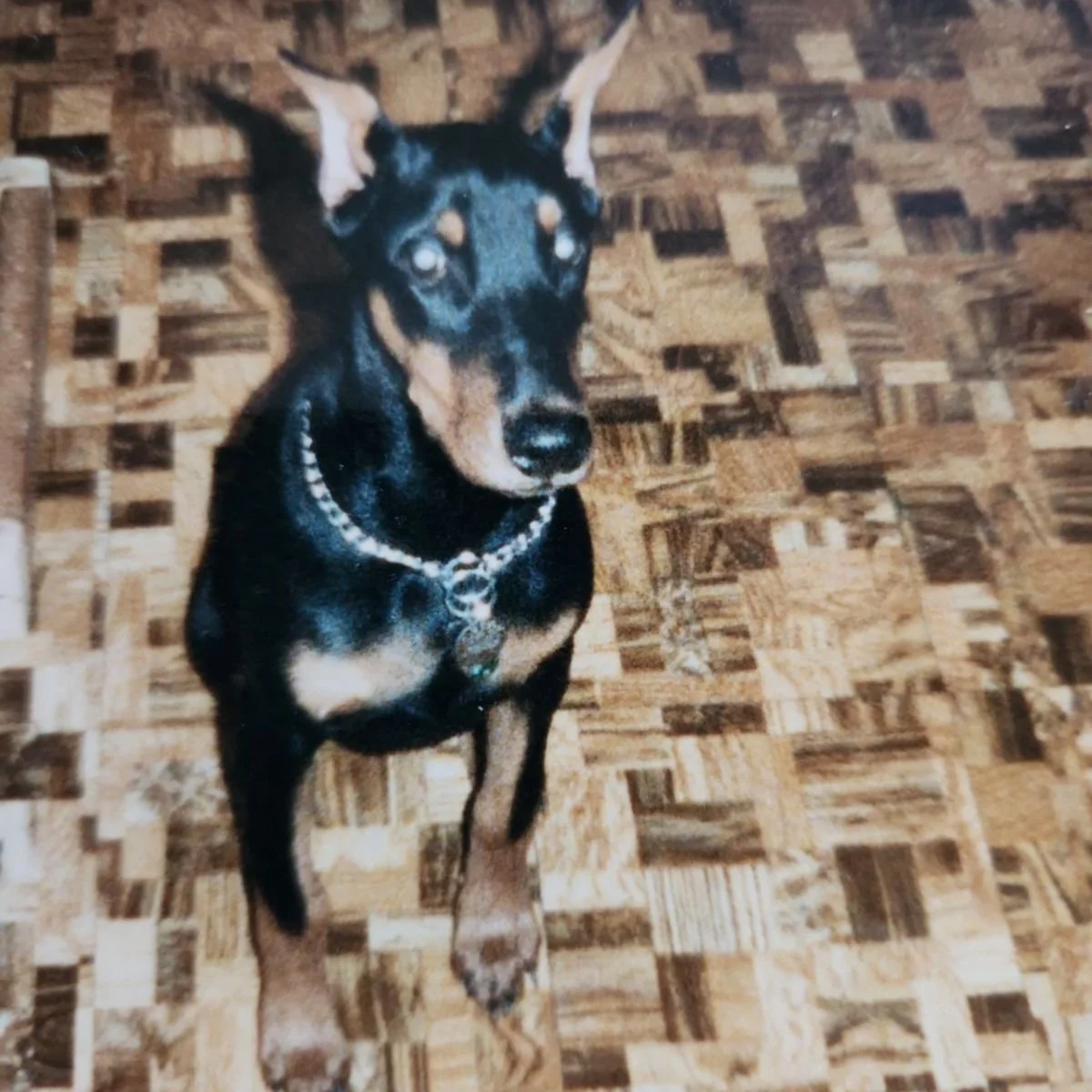
A photo of Chatzi against a “stunning”, 1980-style flooring back drop
My aunt use to breed and show Dobes and so we’ve had a lot of them in my family. He passed away when I was about 6 years old and so there’s a sort of trauma bond there with Dobermans. They were his “heart breed” and so they became mine. I rescue them in his memory, in part.
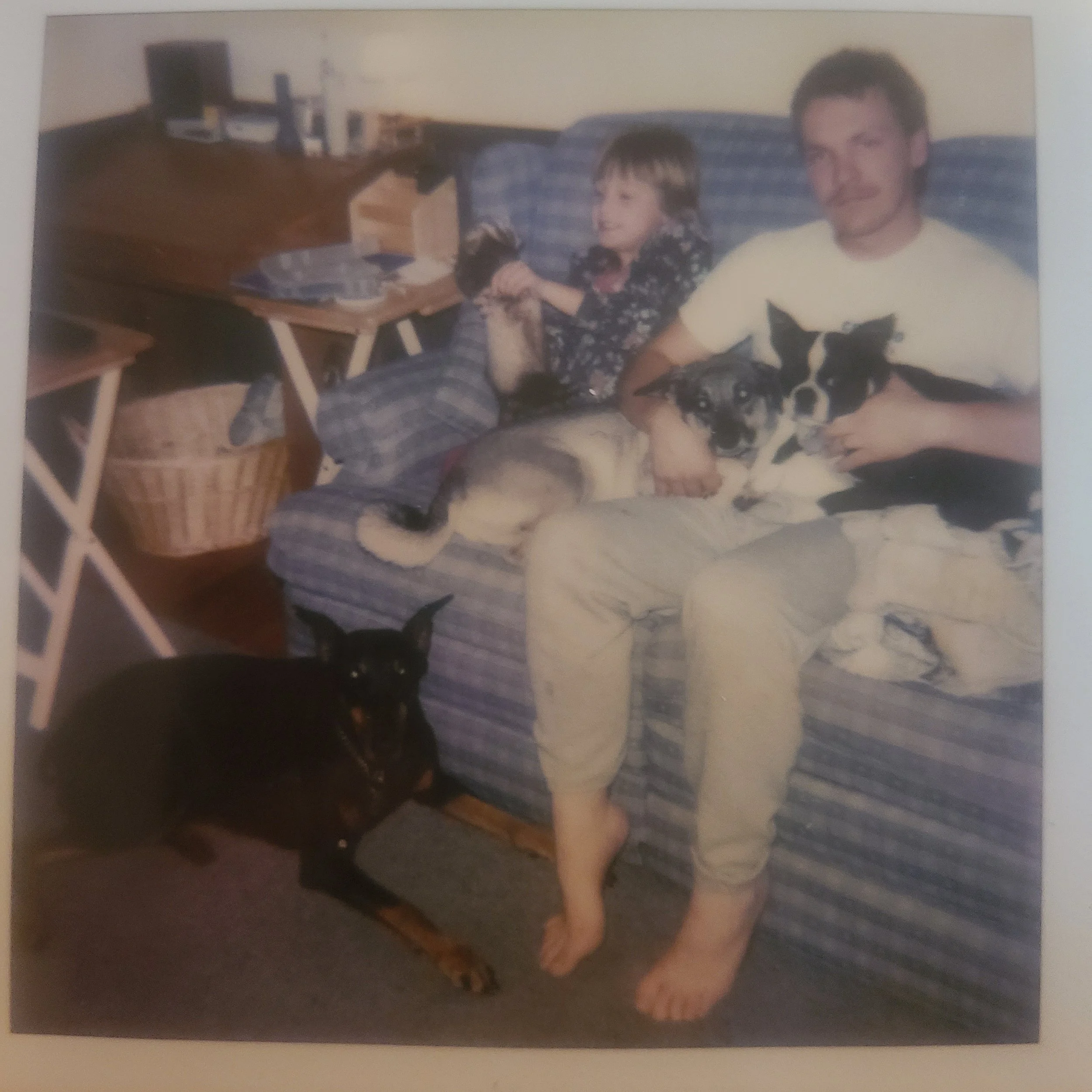
Me and my dad with our Doberman, Dutchess, who was Chatzi’s mom and joined our family after retiring from breeding. Also pictured is Joker (Boston Terrier) and Tucky (Shepherd mix, probably).
Fast forward to adulthood! I owned Dobe littermates already and I’m not going to lie, I was under the influence one night in 2011-ish and feeling sad about them getting older. I was thinking about how (for my next Doberman) I wanted to rescue. I decided to Google “Doberman rescue in Illinois” and lo and behold - Illinois Doberman Rescue Plus popped up as the first hit.
I had no intentions of adopting but I wanted to see how many they had - A LOT! I stumbled across a picture of this dog below and fell in love. I couldn’t get her out of my mind and a few days later, submitted an application to adopt her.

The first photo of Remi FKA Mila that I ever saw on the IDR+ website
We went to meet her in the middle of a snowstorm. Her foster mom had a German Shepherd who was extremely socially selective with people. We probably stayed an hour or two and halfway through the visit I was playing fetch and tug with her GSD in the yard. She was pretty shocked to see this and mentioned to me that we’d be a great foster home and should consider volunteering.
So, like most people, I was swindled into volunteering - LOL, JUST KIDDING. I am really bad at saying no though (especially with charity and donating), so I agreed to sign on.
My husband and I attended an adopt-a-thon some months later and handled a Doberman, Kongo, that was being kenneled at the time. We really liked him and so we agreed to foster him and the rest is basically history.

A terribly grainy photo of Remi and Kongo playing on the floor.
Since then, I estimate that I’ve had 200+ foster animals through my doors - that includes dogs of all breeds, cats, birds, hamsters, bunnies, and probably other random animals. I honestly never kept count because some of them were transient fostering situations, too. Dogs would come here for a few days to avoid being euthanized at a shelter and until a space in another foster home or at our kennels would open up.
A lot of them were normal and healthy, but a lot of them were medical or behavioral rehab cases - specifically the dogs. Rehabbing dogs with skin issues was my specialty, but I was one of a few foster homes who took in reactive or otherwise behaviorally-needy dogs to evaluate and train before being adopted out.
I had a nervous Doberman in my care and the rescue sent a positive reinforcement trainer over to help me. He had that dog behaving better in 90 minutes than I did in 2 months.
I was pretty blown away by the process and continued to work with this company for other fosters. As we worked and trained together more, he asked me if I’d ever considered becoming a trainer. At that point, I really had not. I was a career-long, high-level administrative professional, but it was flattering.
Sometime around 2019, I ended up getting hired by that company to do their admin work and eventually worked my way up to Program Manager. I ran the office, answered phones, triaged clients, wrote the trainers’ training plans, worked with veterinary behaviorists closely, and networked like crazy. It was thousands of hours and hundreds of “case studies” that I got to witness and be a part of.
And so, here we are today with my own company and my own personal flavor. I have never been happier in my life with my career - and that’s all thanks to rescue.
Why I continue to foster
I’d like to give perspective into my personal logic for fostering and why I feel it is such a valid route to go:
Blah, blah, blah it’s rewarding, right? It is - but I don’t actually want to focus on that generic/cliché reason today. I originally began fostering to support a cause that I believed in and because it is rewarding. I keep doing it for the same reasons and because of different ones, too!
Honestly, if you’re in the market for a dog, fostering to adopt is the perfect solution and I strongly believe everyone should try it. I have been fostering for so long now that it is hard to imagine welcoming a dog into my home any other way.
What better way is there other than “test driving” the dog in your home? If it doesn’t work out, you still helped that dog find a forever home - just not with you! It is as low-commitment as you can possibly get!
Choosing the right dog for me
One of the perks of fostering is honestly that if I am in the market for a dog, I get first pick of nice dogs. I know - GASP! I am a rescuer/welfare professional that doesn’t typically keep behaviorally and medically-needy dogs.
Most of the general public doesn’t knowingly take these types of dogs on either or approach a rescue and ask for their hardest/most expensive dog. I’ve discussed this in several blogs and podcasts already, so I don’t think my opinion on that is any sort of secret by now!
There is a weird precedence in rescuing that rescuers always keep the difficult ones that no one else can handle. Some people even wear it like a badge of honor and that’s OK if that is your thing.
But honestly, it is not my thing. Even though I am a professional trainer, I desire what most of the general public wants in companionship with an animal - an easy relationship.
Here is the truth: I love to spend my time professionally helping spicy dogs, but I have an extremely specific set of needs for my household and lifestyle.
I know which types of dogs will thrive in my environment and which types of dogs I can offer the very best life to. It is not a high energy, busy dog that requires hours of hands-on attention every day. I simply cannot give it because I also have a family and run a business. I have my own interests that I like to sink some time into.
I personally believe rescuers and trainers deserve nice dogs if they want them. They spend most of their time helping dogs that if they don’t feel like living that lifestyle 24/7, they shouldn’t be expected to. If that means they want to seek a reputable breeder or keep nice foster dogs, I support that.
I’m actually prepared to catch a little heat for this blog. Animal welfare people are always preaching about doing your research on breeds, temperaments, and being realistic with the capabilities of our pets.
So, just a friendly reminder that this is exactly how I do my research into the right dogs for my home!
I am not knowingly taking on a dog that I cannot enrich and fulfill. I do not have unrealistic views on dogs, in general. If life changes and the dog in front of me begins struggling for any reason, I will calibrate any and all expectations.
Truthfully, my expectations for the dogs in my house are pretty low - make safe choices and that is about all I ask. Otherwise, they’re free to be a dog!

So what am I looking for in a dog?
Must get along with cats - this is SO very non-negotiable for me. I have always had cats and I always will. My cats were here first and this is their house, so any dog I choose to keep cannot stress my cats out. That is unfair to my cats! If I’m in the market for a dog and I bring it home and cannot mingle them with relative ease or a little elbow grease, it’s a non-starter for me.
Must get along with my resident dogs - see above reasoning.
Must be safe with kids - also non-negotiable. My child’s safety, and that of her friends’, are a priority. If a dog poses a risk to a child in my home, it is a liability and safety issue.
Obviously, there is nuance here like having taught my child how to be appropriate with dogs and supervising them together in the first place. While I don’t expect dogs to accept every single child they meet and prefer to keep them contained around strange kids, they also can’t be an immediate risk to a child if there is a management failure.
Must be laid back - we are actually quite a lazy household. We love to vegetate with regularity. We love taking sniff walks and hanging out outside, but the pace of our lifestyle is pretty average. I am not a hiker or a runner, and I really don’t desire to take my dogs to public places like stores and restaurants. All of my dogs adjust easily and they bend and sway with whatever we decide to do.
I tend to prefer older dogs that are past adolescence. I can do without the puppy nipping/mouthing, chewing, potty training, impulsivity, etc. A lot of these things are age-appropriate until 6 months old and sometimes longer! That is a LONG time!
Despite our best efforts with puppies, it is not always “all in how you raise them”. Dogs will often hit social maturity and become socially-selective. I’d rather pick a dog based on who they’ve turned out to be as an adult.
I genuinely do feel that many households with puppies might have been happier with older dogs - sorry to say that.
Must be relatively social with guests - we don’t have a lot of visitors to begin with and one of my dogs requires proper greetings, but the process isn’t laborious for me. Like most of the general public, I’d like to relax when guests are over.
Sometimes that does mean containing my dogs till my guests leave and I’m also OK with that, I’d just prefer they not be a risk to visitors in the event of a management failure.
I really don’t feel this list of needs is lengthy. It is my bare minimum and it’s honestly quite average. My desire is to have a nice family pet.
If you have a longer list of needs, I would encourage you to be ready and accepting of losing some of those capabilities - especially when getting into things like having playdates with lots of strange dogs, attending daycare, going to dog parks, restaurants, etc. The longer your list gets, the harder it is to hit them all and potentially the more unrealistic you’re being with the capabilities of most dogs out there.
Think of the most basic things you’d like in a dog and pursue those with foster-to-adopt situations. Stick to your list of needs when deciding whether or not to adopt!
Fostering has taught me so much!
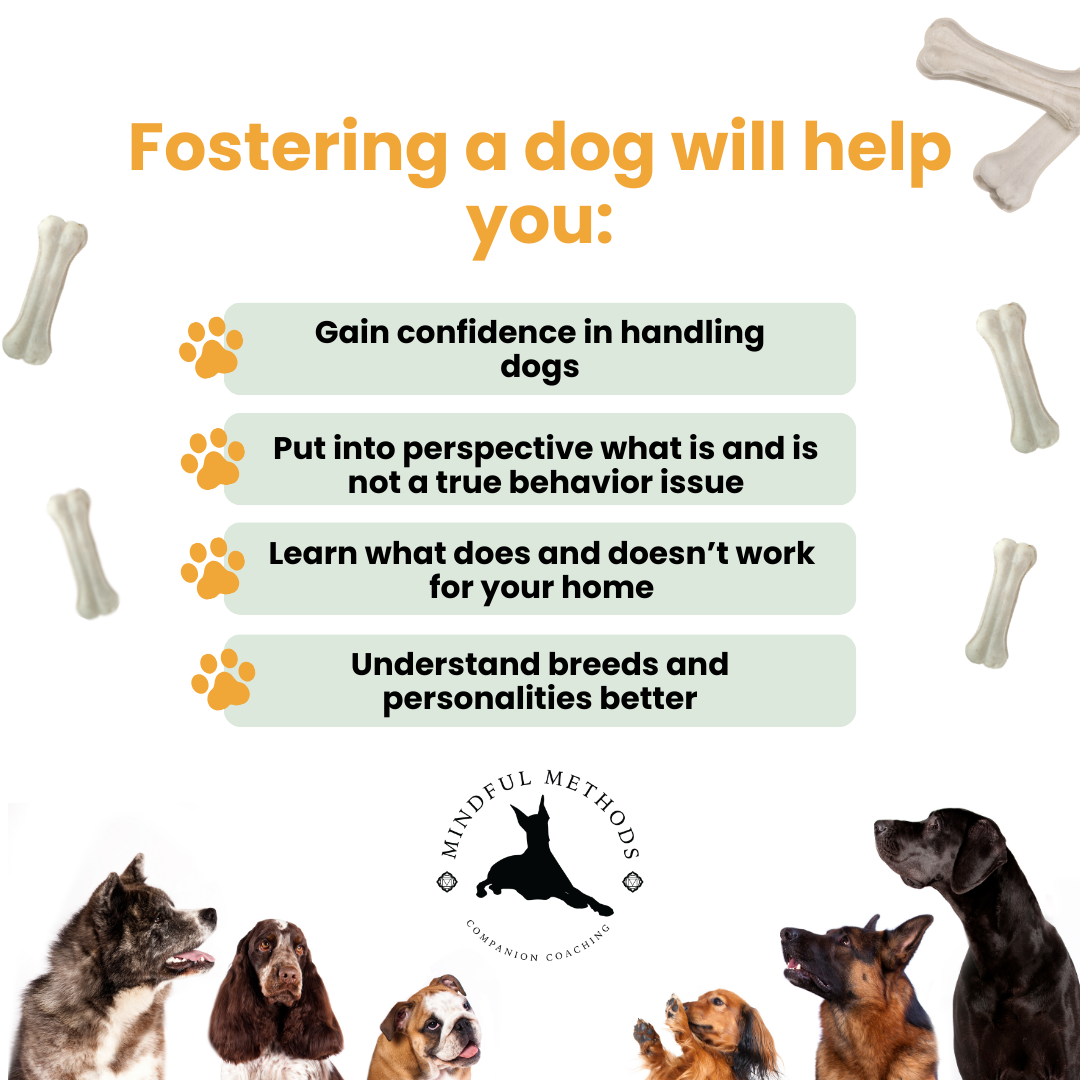
I don’t think this can be overstated - getting your hands dirty with a lot of different personalities really puts into perspective what is really a behavior issue and what is not.
There have also been quite a few times that I’ve thought a certain breed would be great for me, only to foster several of them and find out we aren’t actually a good fit.
Expectations on dogs are insanely high these days in a world that just keeps getting more and more busy and confusing for them. You learn quickly what does and does not work for you, too!
The most confident handlers/trainers I’ve ever met are usually seasoned foster homes. If you want to gain confidence in your skills and guardianship, foster some dogs. You will be well-prepared for a lot of different issues and possess the confidence to navigate them.
Practice makes perfect, right?
“But, I will just want to keep them all!”
This is a really common objection to fostering and I really do not feel that this is true. Some dogs I have fostered have been such a poor fit for my environment that it was a relief when they were adopted. It is what it is - my home is not a good fit for every personality.
If you keep your eyes set on the type of dog that is right for you, it is easier to allow them to be adopted. Keep in mind that you’re making a huge difference in the world of rescue - and to that individual dog when you place it appropriately.
A high energy dog is well-placed in a household that loves being on the move. A lazy dog will have a hard time with these expectations, and vice versa.
Furthermore, if a large medical bill for one of my animals would result in sacrifices to care or quality of life affordances to another animal, that is a big deciding factor for me in how many animals I can be financially responsible for.
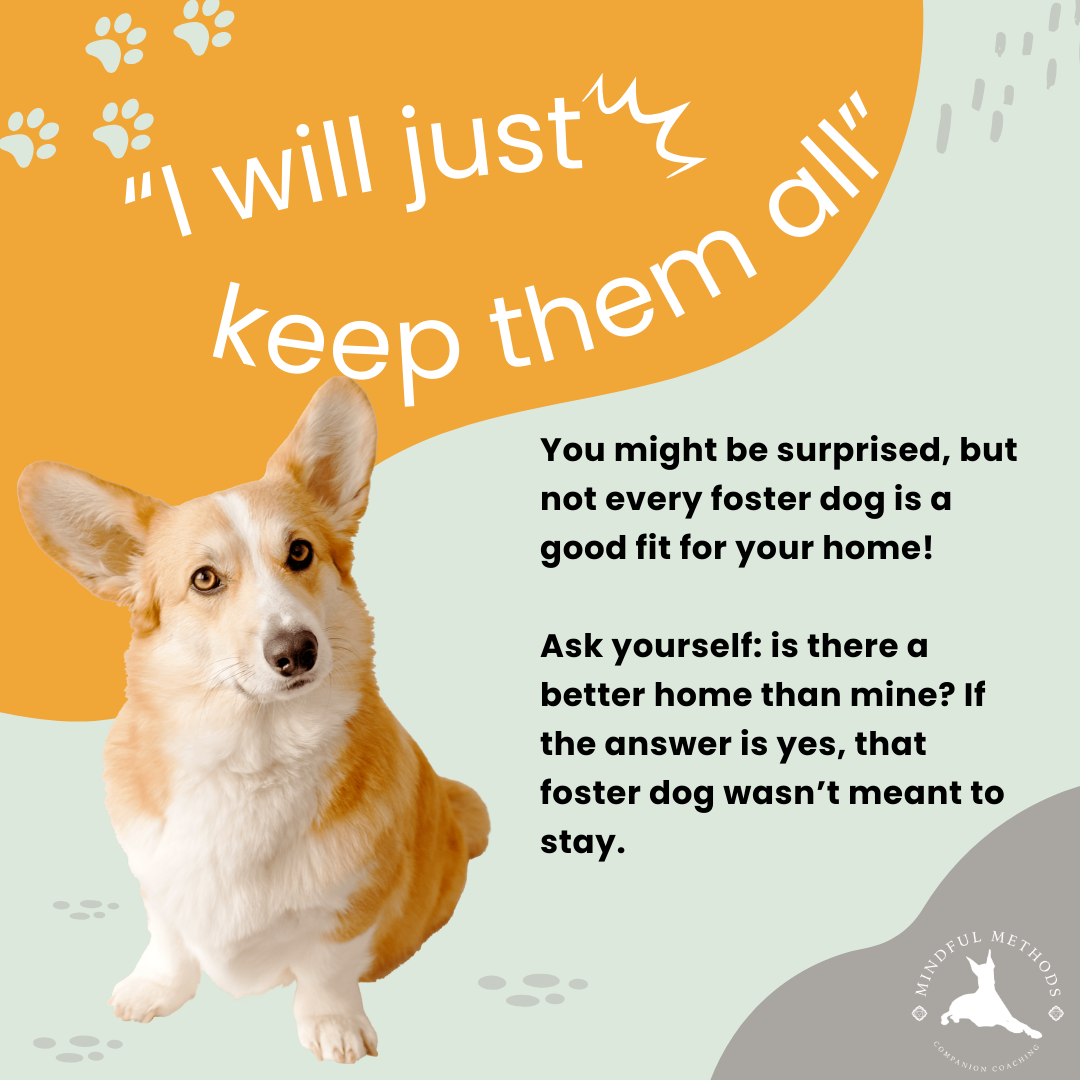
I always ask myself, “is there a better home than mine?”
Even as a professional, the answer is often, “yes”.
If that is the case, that isn’t meant to be my dog.
What is the hardest part about fostering a dog?
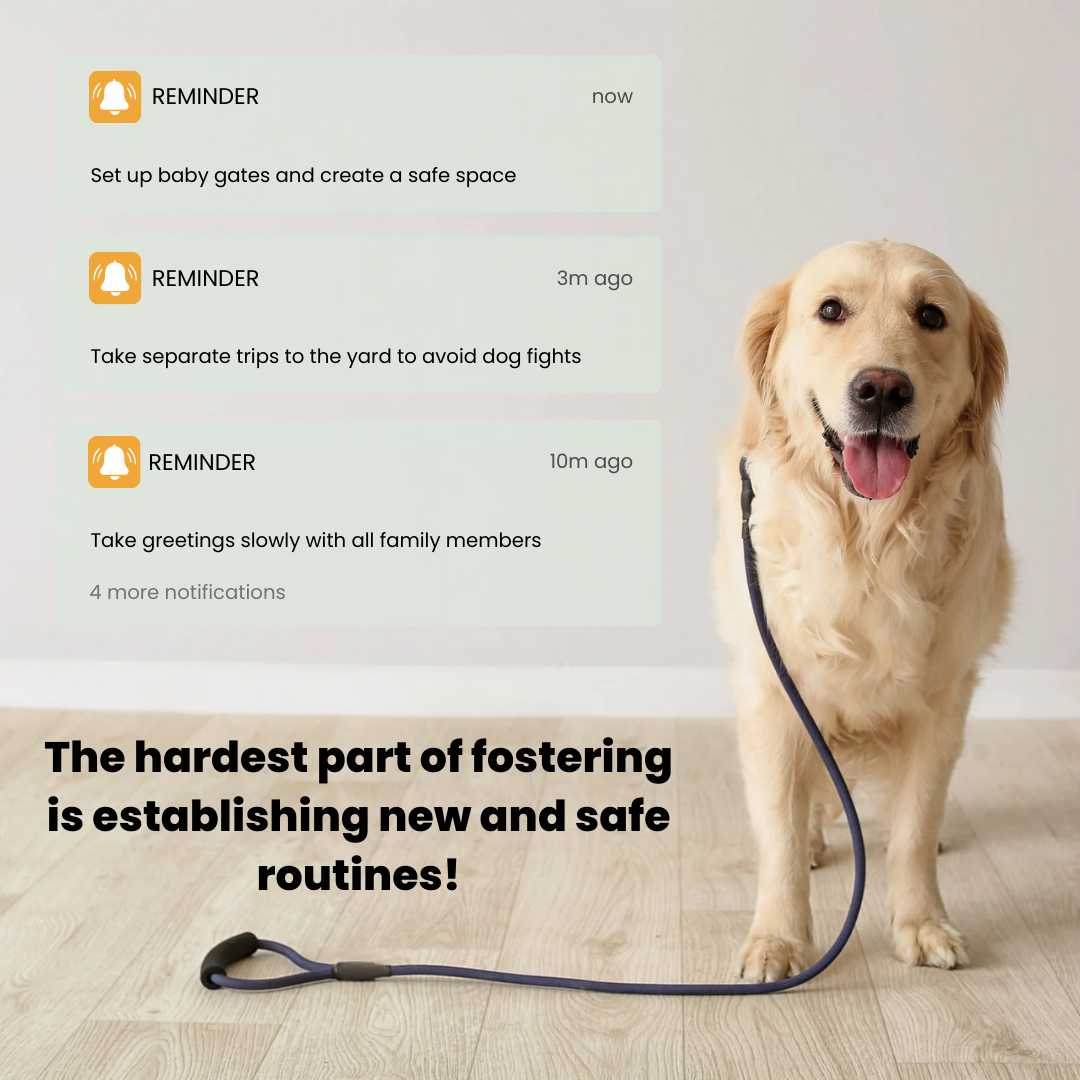
To be honest, the hardest part is new routines. Integrating a dog can be challenging but once you’re well-practiced it is relatively easy.
Setting up my household with more baby gates than usual isn’t ideal, but it is extremely temporary. Separate trips to the yard to avoid incidents/dog fights while I am learning the new dog’s personality is a minor inconvenience. In the grand scheme of things, even though this is the hardest, it still isn’t hard in a traditional sense.
I’ve had A LOT of dogs here and so there has been wear and tear on my yard and floors. All things considered, we’ve fostered some really excellent dogs in our lifetime and the damage is pretty minimal. These are just material things, at the end of the day.
And yes, I have fostered and let go of some really amazing dogs that were a good fit for my home. If I had room, I’d have loved to keep them, but I have a limit here.
I stick to my guns! If I adopt every nice dog I meet, I don’t have room to foster anymore and another nice dog never gets a second chance.
Eyes on the prize! The more you foster, the easier it gets - I promise!
How to get started with fostering
I have a great resource on finding the perfect companion for you and in it I detail what sets apart a spectacular rescue organization. I recommend reading that to ensure your values on quality of care are in line with theirs.
Many organizations sponsor ALL bills - toys, food, and vetting. If nothing else, this is a sign of a well-fortified and responsible organization when they can accommodate even the most basic needs of a dog in their care.
Generally speaking, most organizations will treat your interest in fostering like an interest in adopting. You may be subject to the following:
An application process
Landlord check (if applicable)
Vet checks on current and past pets
Home visits
Find a local organization that you are passionate about and approach them to foster. Many times there is a great need for vacation and other temp fosters as well as long-term foster homes. This can be a great place to get your feet wet.
Organizations may or may not have foster-to-adopt programs, specifically. Most of them allow foster homes to adopt their fosters, regardless. In foster-to-adopt programs, I like to see organizations offering those homes an extended period of time to get to know the dog - at least a month.
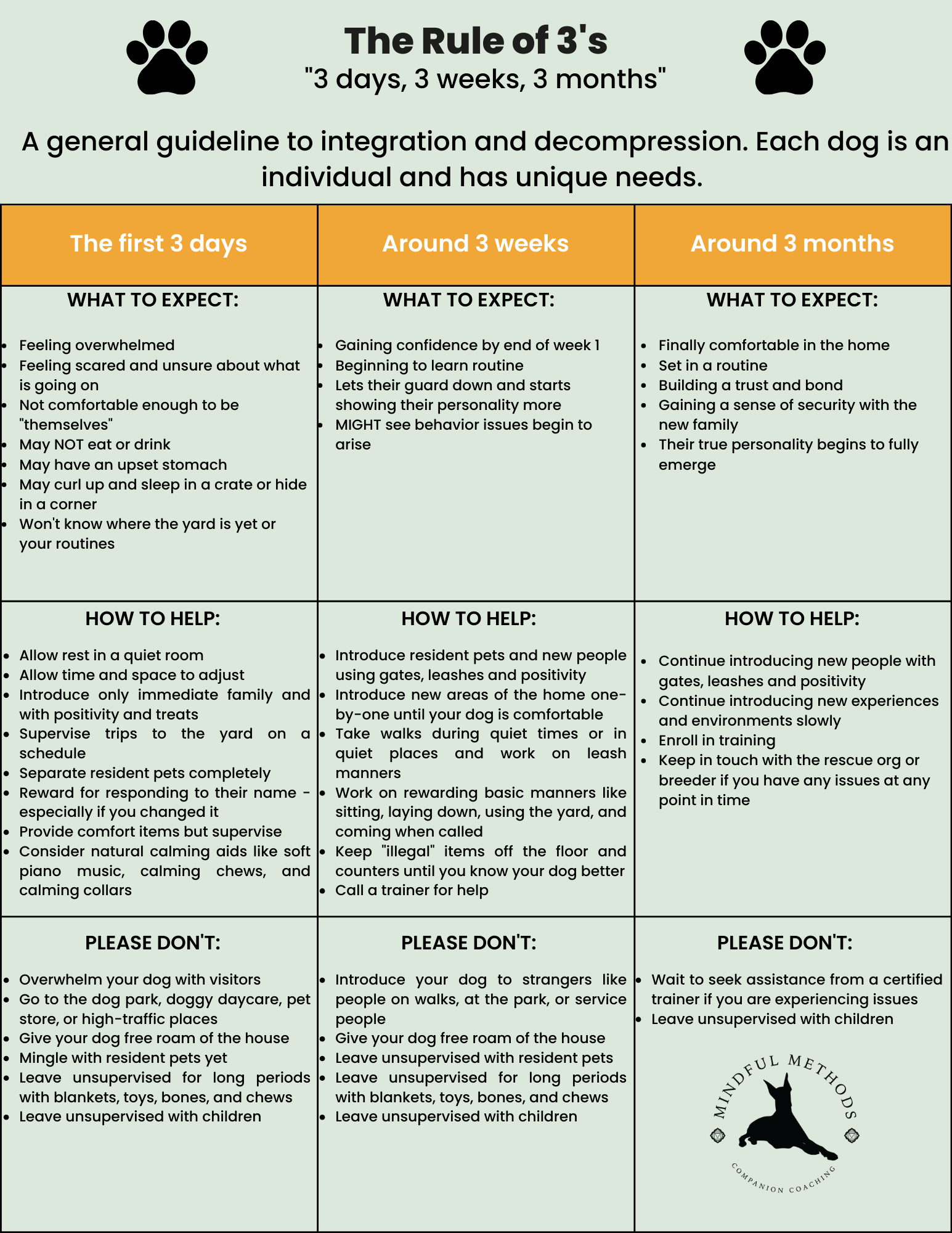
Keep in mind the rule of 3’s, as shown below. 3 days to decompress, 3 weeks to begin learning routines, and 3 months to really see the true personality of the dog. This is just a general guideline and based on each individual dog this could be longer or shorter. I personally like to see what a dog is like in my home for about a month before making a choice to adopt.
So what do you think? Have you considered fostering before? What is holding you back? Tell me about it in the comments!
Written by: Jessie Kasper IAABC-ADT, FDM, FFCP, PNCC
Mindful Methods Companion Coaching