
Fish Out of Water: Behavior Problem or Breed Trait?
*This post contains affiliate links and may be eligible for commission at no additional cost to you*

Who doesn’t love a good character development arc and origin story? Today we’re going to take a trip down memory lane and discuss the origins and ethology of the different dog groups. Buckle up, it’s a long one but one that I hope you find fascinating. (There will be links available to skip to specific breed groups!)
I’m going to tell this story using memes as I had wanted it to be humorous on social media and then it got such a positive response that I wanted to centralize the information, so here we are! In case you missed it on my socials, this is my Fish Out of Water Series - now with expanded sections and more memes!
This isn’t your grandmother’s AKC dog groups, either. These have been recategorized closer to their original breeding purpose. This is inspired by the LEGS Applied Ethology Family Dog Mediation course that I took.
If you haven’t picked up the book “Meet Your Dog” by Kim Brophey, I highly recommend grabbing it because it is much more thorough than I could ever be in a blog post.
Meet Your Dog online also has a brand new site in the works which is starting to break down the individual breeds more and what you can expect. I had the privilege of being selected as a breed expert to contribute to the Doberman category. This is a wonderful resource if you’re choosing a new companion.
So, let’s get after it, yea?
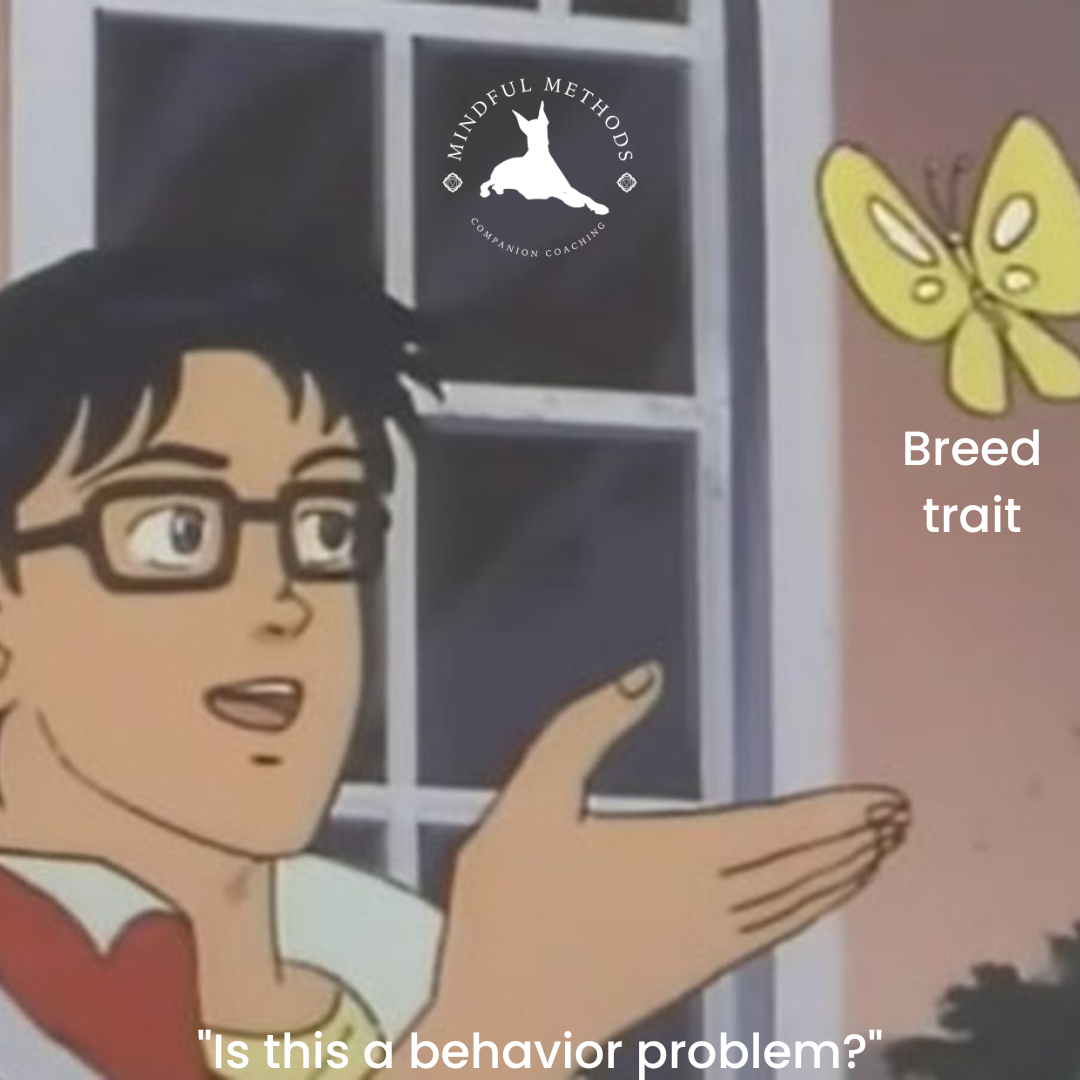
OK, OK - before you come for me, I warned you that I was using memes. Memes are often oversimplified and lack nuance, and that one is exactly it.
Even if something IS a breed trait (in or out of context), it can still be undesirable to pet homes or even dangerous to the animal/public and that is often what is happening.
Before we get into the groups, I think it’s important to understand my overall philosophy and why I think educating on breeds is important:
Firstly, I spend A LOT of time helping clients understand the dog in front of them. In order to enact real behavior change, it is crucial to understand our dogs as individuals.
It is NOT all in how you raise them and in fact, I find that statement incredibly harmful and dismissive of the very real things we selected for in certain groups. This sentiment is responsible for people choosing breeds based solely on looks instead of what breed might fit best into their lifestyle. I have worked with families who have done everything correctly and still had poor outcomes, and I have worked with dogs (particularly in rescue) that have been failed miserably and still come out resilient and well-rounded.
Behavior is influenced by many things including prenatal development (yes, behavior starts in the WOMB), genetic influence, health of the dog, past and present learning history, and the environment past and present. ALL of these things make up who your dog is!
Just because your dog IS a certain breed doesn’t mean they will BE these things - just that there is a higher probability, especially when coupled with other factors. For example, dogs bred to guard are more likely to not be welcoming to “strangers” in your home!
“Undesirable” behavior is often an expression of unmet needs, so my first order of business is figuring out where the deficits are and addressing those. Is the dog bored? Sick? Tired? Hungry? Thirsty? Just simply never been shown what to do instead? We have to address these basic quality of life issues before creating training plans. Once needs are met instead of suppressed or ignored, what is actually left to modify?
Dogs these days are a captive species. Yes, I said what I said.
The idea of dogs as “pets” didn’t really occur till around World War II when farmers needed to make extra money and began breeding dogs to market to the general public. Up till this point, dogs had very specific jobs and spent their days outside working, sleeping/resting, foraging, digging, hunting, mating, running, and had more autonomy over their choices. Many of them spent a limited amount of time indoors.
This current captive lifestyle is a blip in the history of the dog and genetic memory doesn’t have the tools to cope with this yet. This is where “fish out of water” comes into play. Our world is changing faster than ever before and dogs simply don’t have the capability to comprehend things like urban sprawl, electronics, moving cars, packed public places, etc.
Captivity comes with drawbacks behaviorally and it is up to us to enrich the micro-environment (like a zookeeper) and provide dogs with an outlet for the expression of species-specific behavior - ESPECIALLY expressions of behavior we purposely selected for. Many things including repetitive behavior and aggression can arise from being under-stimulated (think of zoo animals kept in poor conditions, pacing mindlessly).
Dogs are one of the MOST adaptable species in history. They take A LOT of things in stride and have really found themselves a niche living alongside humans, but it has come at a cost to them. We hold expectations for their behavior that we don’t even hold ourselves to when we feel overwhelmed.
Historically, dogs have thrived and survived by living alongside and attaching themselves to humans that provide resources and show them kindness. “Street dogs” often CHOOSE their favorite humans that they visit or follow around. They would NEVER choose a human that hit them, scared them, yelled at them, or threatened their safety - they’d move on and seek someone else that could predictably benefit their survival. All of the scientific studies aside supporting positive reinforcement, this is an observable, natural trait in street dogs today.
Thus, traditional methods and mindsets around training dogs and meeting their needs requires a MASSIVE shift in perspective.
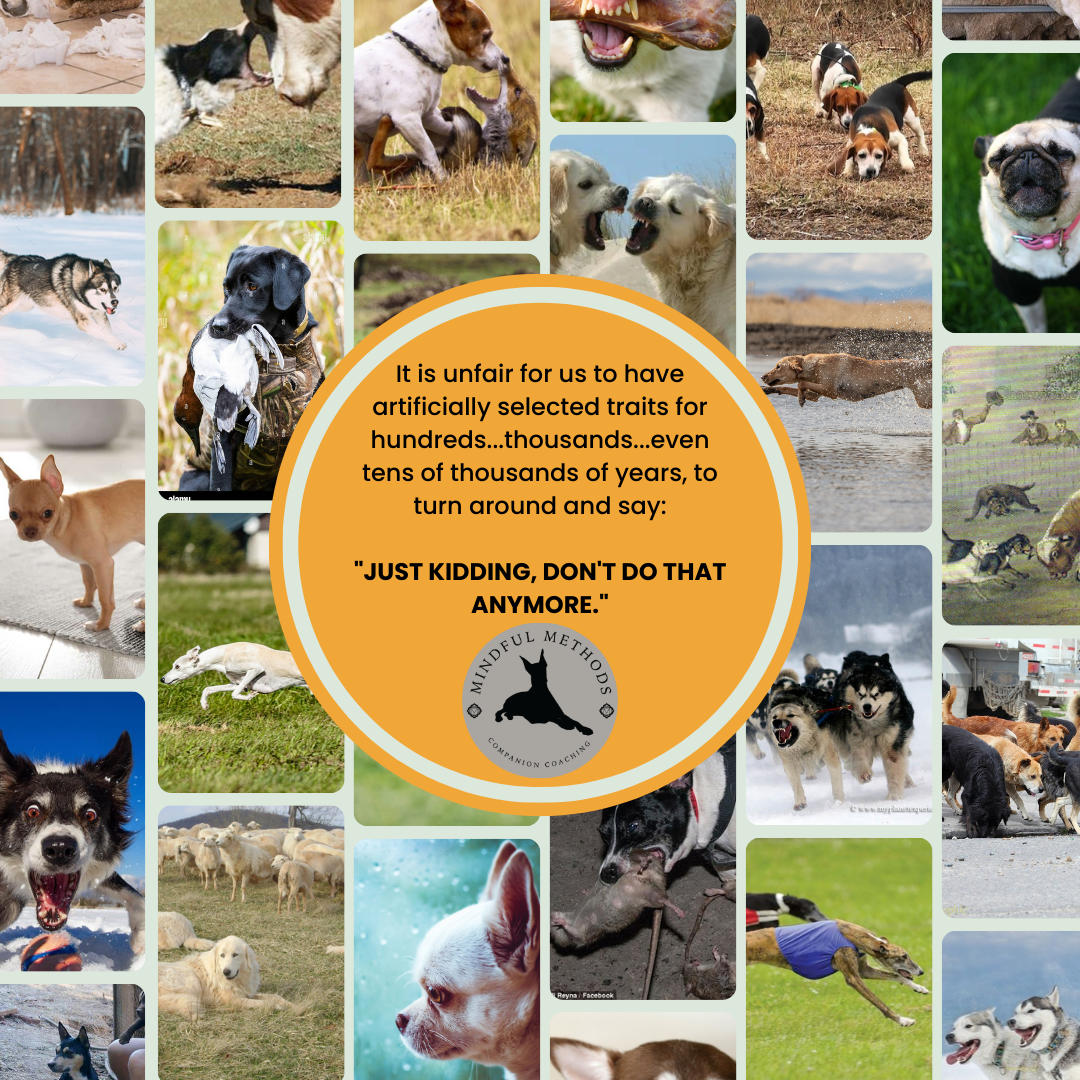
The object of this blog is to facilitate a shift in mindset and help calibrate expectations.
This blog is best viewed on a desktop computer. Mobile load time for meme galleries may be lengthy. Links to an external meme cache folder are provided in every section for your convenience.
Use the links below to jump to specific sections! Even if you bounce around, I highly recommend reading the bonus ethogram material - it is fascinating!
Natural Dog Sighthound Guardian Toy Scent Hound

Incoming language warning: these memes were meant to be funny, light-hearted (but serious), and channel the frustrations of pet owners - and so they contain some adult language. If you’re offended by curse words, skip this blog post.
Natural Dogs


Is life with your unemployed Natural Dog super dramatic? Not entirely surprising. These dogs are called "primitive breeds" by some as they were the first iteration of domestic dogs from their wild wolf ancestors. Truly wild at heart, they were the first all-purpose working dog. We needed them to pull and transport our things, hunt with us, protect us and our flock, herd for us, and many others.
Genetic memory and sheer instinct favors freedom here as they’ve spent thousands of years running incredible distances. They can be incredibly discerning, with a strong sense of self-preservation - because they had to be! The wild world is dangerous!
Your Natural Dog may be reactive or wary of strange people and strange dogs. Ever seen a pack of Natural Dogs pulling a sled? They’re all barking and excited, feeding off each other to get the job done, aren’t they? Your Natural Dog may be incredibly vocal - always talking to you and trying to tell you something!
The Husky is an easy target for this one due to their popularity, but many other breeds fall within this category. Off-leash, autonomous outdoor time and access to run is VERY VERY VERY important to Natural Dogs.
Your "choose your own adventure" as a pet home may look something like this:
Doesn't come when called
Runs/wanders away
Struggles with confinement (read: leashes, crates, gates, closed doors, living in a house/apartment, fenced yards, any physical restraint)
Struggles being left alone
Easily bored/destructive
Jumps the fence/escape artist
Wary of other animals and people
Poor leash manners
Hates being groomed
Frequently disturbs the peace through whining, barking, and howling
If memes are not working, here is a meme cache for you to visit!
Sighthounds


Sighthounds originated in Africa and were further developed in Ancient Egypt and the Middle East. These were the first breeds further selected from Natural Dogs (above), and so we can see some suspicion and/or wariness of perceived threats given their primitive lineage. These dogs may be socially present and exist amongst humans, but may not be overly affiliative, and appear rather stoic towards unfamiliar people.
We selected them for their excellent peripheral and long-distance eye sight. Form follows function with this breed (and all breeds). Their sleek frame lends to their incredible speed and stamina, and the elegant shape of their head enables their excellent vision. Off-leash, autonomous outdoor time with space to run is VERY VERY VERY important to Sighthounds.
You might find Sighthounds easier to live with than some other breeds. They tend to conserve their energy until they need to use it, so they can be quite laid back during downtime despite the common perception that they're high-energy dogs.
Greyhounds are the butt of a joke about being unable to learn to sit on cue. Sighthounds in general are often categorized as being poor at following instructions/obedience training. They can be taught, we just really didn't select for sitting and so genetic memory might find your requests weird and foreign.
We also selected them to be specifically motivated by fast-moving objects and to conserve their energy, so your Sighthound may be sizing up the situation and trying to determine if it is worth “wasting” energy on. Traditional methods of reinforcement may be more difficult.
Your "choose your own adventure" as a pet home may look something like:
Predatory behavior towards other animals
Difficulties with children in their space
Wary of strange people and dogs
"Sudden" reactions/hard to decipher mood
Not coming when called
Hard to motivate and train for obedience
Escaping and running away
Intolerant of rough play styles, extreme weather
If memes are not working, here is a meme cache for you to visit!
Guardian Dogs


Selected for the job of guarding, these dogs go back to 1100 BC and were used to protect resources from predators and people. They were largely kept outside 24/7 and many still prefer it that way!
There are different types of guardians and based on what they were selected for, temperament may vary slightly. Some Guardian dogs have a pretty sordid history as being used during Roman times in the Gladiator rings and “dogs of war” during conquistador periods, and so were bred for their brutal power. (More on that in the Bull Dog section below!)
Guardian dogs can be cool, calm, collected, and can be quite tolerant towards social members, but can definitely be protective towards unfamiliar people and dogs. A well-balanced Guardian dog will have excellent discernment - what is and isn't a threat - and what is and isn't worth wasting energy on, by proxy.
This can come off as being harder to train, but Guardian dogs are known for conserving energy until they need it, and also for completing their job independently without much input from us.
Your "choose your own adventure" as a pet home may look something like:
Difficult to motivate/”stubborn”
Wanders off
Doesn't come when called
Suspicious/reactive towards animals and people
Barks a lot
Handling intolerance for grooming/vetting
Guards resources
Protective/territorial
Fighting with other housemates, particularly same sex
If memes are not working, here is a meme cache for you to visit!
Toy Dogs


Some would argue that modern toy breeds are more in their element than their larger counterparts, considering we literally bred them to be our constant companions. Some of these breeds are ANCIENT and were used as literal lap warmers, flea magnets, status symbols, and for guarding palaces. These breeds were some of the first who were readily invited into our homes and actually expected to live alongside us 100% of the time, thus most are extremely sensitive to the elements.
Fun fact: most modern toy breeds carry 1-3 genes for dwarfism. We favored small features and childlike mannerisms. Everything about them is teeny tiny, thus the world can feel incredibly scary in a number of ways. This can result in reactivity towards adults, children, and other animals.
It's tempting to carry and cater to your toy breed 24/7, but this can result in issues with independence and autonomy. Many struggle with handling, grooming, and confidence in novel situations - but you'll adore their cuddly disposition!
Your "choose your own adventure" as a pet home may look something like:
Difficulties potty training
Separation issues
Clingy
Alarm barking/yappy
Reactivity to animals and children
Lap guarding
Area guarding
Handling and grooming intolerance
Sensitive to cold, heat, injury, stress, etc
If memes are not working, here is a meme cache for you to visit!
Scent Hounds


Scent Hounds are a BLAST! They're highly emotional with BIG personalities. Hunting in large groups, they can be affiliative towards other social members, which can make them easy-going housemates.
Scent Hounds have unique baying barks, so that we could follow their mark better. We wanted them highly emotional, vocal, and to persevere at all costs. Scent Hounds adore the outdoors - loving to run, jump, and explore. Genetic memory also favors freedom in this breed and were historically not invited inside until somewhat more recently.
Scent Hounds bring big feelings and big emotions into everything they do and can be a total hoot during training and activities they find enriching. However, we selected them to be “one-track minded” despite environmental distractions. This can make motivating them with traditional reinforcement more difficult, and they can come off as “stubborn”. Regardless, their big, goofy, dramatic personality will make you smile.
Your "choose your own adventure" as a pet home may look something like:
Selective hearing/hard to recall
One track minded/escape artist
Difficulties with confinement
Poor house manners such as counter surfing and raiding cabinets or garbage cans
Socially selective with strange dogs or any perceived threat to security
Difficulty to manage on lead once excited
Barking ALOT
Reactivity to wildlife
Predatory behaviors
Resource guarding
If memes are not working, here is a meme cache for you to visit!
Gun Dogs


When you think of Gun Dogs, you might immediately think of "family pet" - and for good reason! We selected them for reliance and cooperation with humans, especially for hunting hard to reach birds. These dogs were some of the first to share our hearths and be invited inside, too.
Selected to work EXTREMELY cooperatively alongside humans, Gun Dogs are known to dote on their people. Further selected for neoteny (childlike qualities), these dogs can have a happy-go-lucky, easy-going, and down-for-whatever attitude. They can be highly resilient in new scenarios, always going with the flow. They are often athletic and adore outdoor activities, which makes them highly compatible for adventurous families.
Coupled with being bred for retrieving with their mouths, these childlike qualities can result in behavior issues surrounding their mouths and what feels like extended puppy periods. Chewing, ball chasing, mouthing, destructiveness, retrieving everything, and even sometimes ingestion of foreign items can occur without an appropriate outlet. Gun dogs will often self soothe through over-grooming habits, leading to lick granulomas.
Your "choose your own adventure" as a pet home may look something like:
Needy/clingy/overwhelming greetings
Puppy-like behaviors: chewing, mouthing, destructiveness
Obsessive fetching
Noise phobias
Poor recall and highly distracted
Hyper/restless
Self soothing to the point of injury
Catching birds out of the air
Difficulties with separation, particularly when you are home
Ingesting everything
If memes are not working, here is a meme cache for you to visit!
Terriers
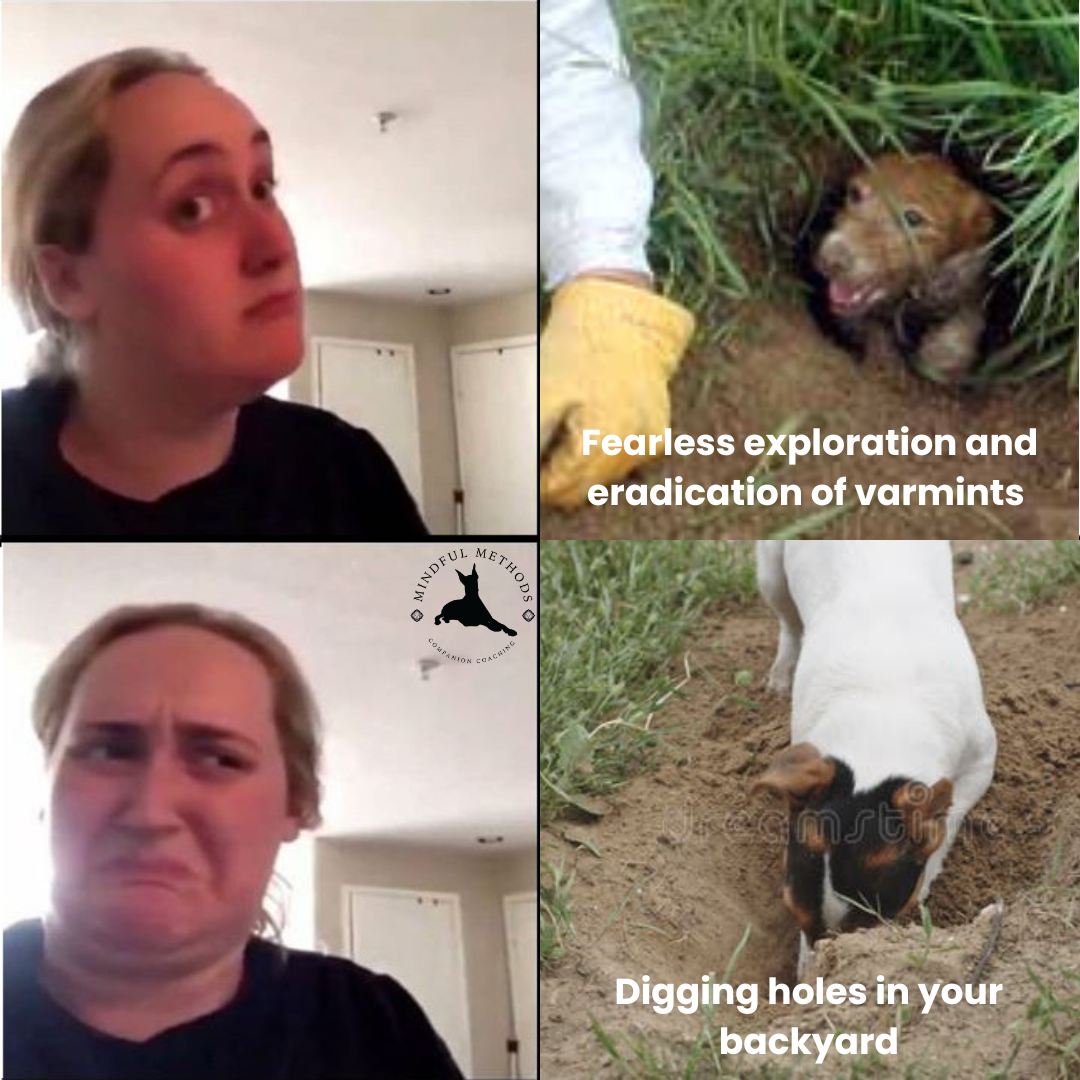
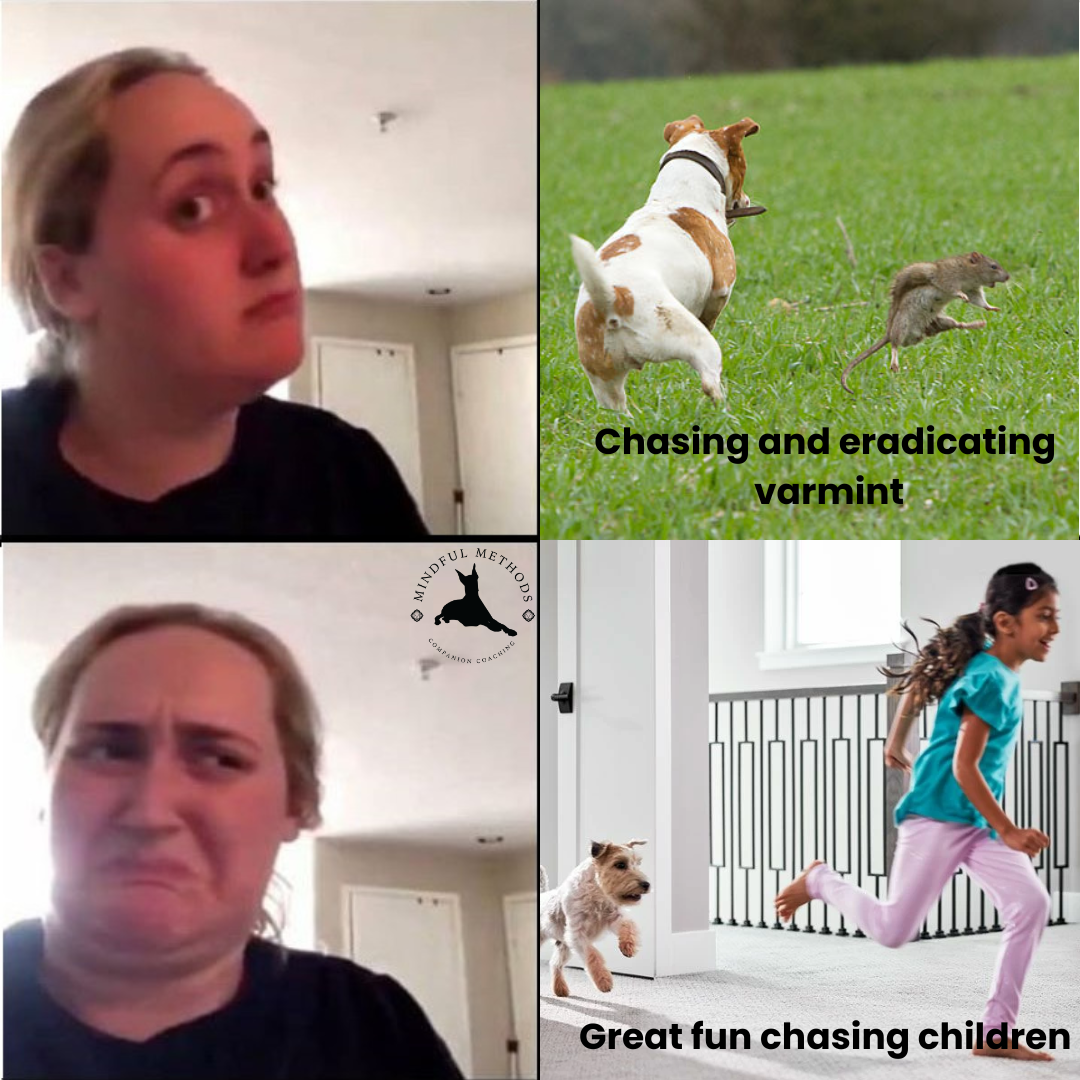


Ah, the Terrier group - full of spunk, zest, and tenacity. This group has lived beside us and been a crucial element in survival against diseases spread by varmint and helping protect our resources.
Unlike other groups who's jobs were to manage (not kill) livestock, we selected these breeds for full physical engagement at the drop of a dime; being less discerning of personal safety; independent problem solving (how can I rip these floor boards up to finish the job?); and overpowering prey using their sheer, unending energy.
These dogs are magnificent, powerful, and cunning when they have a purposeful job to do. They were selected to be social and friendly with humans since they needed to live in populated villages.
Understanding this group and respecting their breeding and limitations goes a long way in aligning expectations.
Your "choose your own adventure" as a pet home may look something like:
Overwhelming play styles towards humans and other dogs
Nipping, mouthing, or biting that may heighten when pushed away or spoken to
Conflict with other animals
Strong prey drive/won't recall
"Unpredictable", explosive, impulsive
Repetitive ball chasing, tail chasing, light chasing
Digging holes in the yard or furniture
Shredding everything
Resource guarding
Territorial/protective
Barking/reactivity
Killing wildlife
Chasing children and other small things
Zooming/doggy parkour
Getting into everything
If memes are not working, here is a meme cache for you to visit!
Bull Dogs


The Bull Dog Group (not Bulldog, although they’re in this group) is one we see lots of here and have a special affinity for! This section deserves a lot of context and is longer than the others.
Some people may view this info as blasphemous. On the contrary, learning the history of these powerful breeds does more for advocation than harmful MYTHS do (ahem, nanny dogs). The public needs to be realistic in their expectations in order to determine if their lifestyle is the right fit, and rescue organizations are responsible for making good placements.
Unlike the rest of these breed groups, you're not going to get any memes and will have to use your imagination as to how these traits get this group into trouble.
There are some really unhinged groups of people that could easily take those memes away from the context of this blog and use it to further their hatred. There is no group that is subject to BSL quite like Bully-types currently are.
Historically we've seen this though with Rottweilers, Dobermans, GSDs, and many others throughout the years - there was even a Spitz panic in the 1870s. These things arise from a fear of what we don't understand. So let's shed some light...
The primary purpose of Bull-type breeds were largely for our own entertainment. Before ESPN and crappy reality TV shows, more primitive human beings would pit animals against each other. We can find this in history as early as the gladiator rings where Guardian-type breeds were pitted against boars, bears, lions, and other very large game (Christopher Columbus also used them for various atrocities).
In certain demographics and geographies, it's still present today amongst a variety of species. Certainly, some Bull-type breeds were also used to guard farms against large game (like deer) that would threaten resources, as well.
Primarily created for Bull Baiting in the 16th Century, we wanted the tenacity and gameness of the Terrier group (presented above) with the size and power of Guardian breeds (also presented above). Due to the different influences, presentations can be highly variable or not present at all. These breeds can be stoic and incredibly gifted at hiding physical pain due to their original breeding.
We wanted them to be affiliative and tolerant of humans and certain animals, but ready to exercise full physical engagement, with less warning, and with far less discernment for personal safety in circumstances where there were perceived threats. Think of it as a "kick ass first and take names later" mentality.
These breeds are generally fearless in their exploration of their environment and can have perseverance in their problem solving. Often, they are ready to rise to the occasion at a moment's notice and can be a blast in training and any activity that requires full engagement of their magnificent muscles, such as pull work and agility.
Understanding these breeds and calibrating YOUR expectations will go a long way in whether or not your lifestyle can accommodate them. If you want a happy-go-lucky, agreeable, and soft companion in all situations, consider a different breed group when shopping around. WE are the biggest problem historically and currently when it comes to these breeds.
Your "choose your own adventure" as a pet home may look something like:
Overwhelming play/greeting style with humans: jumping, nipping, mouthing
Overwhelming and confusing play/greeting style with other animals leading to accidental altercation in some cases
Socially selective with other animals or outright aggressive
Zooming, doggy parkour, getting into everything
Prey driven with poor recall
Resource guarding
Protective of the home and social members
Reactive/unmanageable on lead
Over arousal and excitability
"Unpredictable", explosive, impulsive
Destructive: digging, shredding, chewing
Repetitive behaviors: ball chasing, light chasing, spinning
If memes are not working, here is a meme cache for you to visit!
Herding Dogs


Herding dogs - with such a zest for life, there's so much to meme! You can probably tell by the amount of content per group, which types of dogs we see the most of, too!
Herding breeds date back to 55 BC and are natural environmental managers - and we wanted them this way! Ready to rise to the occasion ALWAYS, Herding dogs sleep with one eye open. You'll adore their energy, but also find it exhausting at times.
Many Herding dogs work with their mouths, and some breeds are so good at it that they've been further selected for protection work. Herders can be fearless and confident in their exploration, sometimes throwing personal safety to the wind in pursuit of fulfilling their instinctual duties.
They're a stickler for law and order and can be bossy. If you have an active lifestyle, they can be excellent companions and they love dog sports like agility. If you’re a couch potato or have a busy family life - consider a different breed.
Your "choose your own adventure" as a pet home may look something like:
Chases everything that moves, including children
Prey driven with selective hearing
Obsessed with balls and fetch
Chasing shadows and lights
Barks constantly
Territorial and protective
Struggles to meet new people and animals
Highly distracted/selective hearing
“0-100”
Repetitively spins and chases their tail
Doggy parkour in the house
Nipping, mouthing, jumping
If memes are not working, here is a meme cache for you to visit!
World Dogs


World Dogs aka "street dogs" make up 80% of the world population of dogs. These dogs are not subject to artificial selective pressure from humans and are genetically diverse, typically containing less than 30% of any single breed in their DNA. These dogs walk a line between truly wild and truly domesticated in many ways - as domesticated dogs of the past largely still lived outdoors, but amongst humans, and had more autonomy over their choices than our captive pets do.
Without human selection in play, natural selection has taken hold and these dogs have survival on the mind. They are great at sizing up any situation (especially where humans are concerned) and determining if it is worth their energy or safety. This can make them not-so-willing to engage in training if they don't feel it serves a purpose for their survival.
World dogs can be flexible thinkers, excellent problem solvers, naturally curious, adaptive, low-maintenance, level-headed, and tolerant. On the flip side, being taken away from complete freedom and thrust into a world of confinement (think: crates, leashes, fenced yards, apartments, houses in general) can be extremely overwhelming for them - and potentially for yourself if they retain more feral habits.
Without selective pressure for niche “jobs”, World Dogs maintain a natural drive to complete species-specific activities and are free to self-entertain. World Dogs are use to having freedom to forage, shred, dig, sniff, mate, run, rest, socialize, and be the captains of their own ships.
Amongst professionals and advocates, this can be a heated topic of discussion regarding welfare and ethics when it comes to taking these dogs out of their natural habitats. They might not have fleas and worms anymore, but are they truly happy as a captive pet? It’s a good question to mull over if you’re considering bringing a former street dog into your home.
Your "choose your own adventure" as a pet home may look something like:
Soils the house
Difficulties with confinement
Destructive
Getting a hold of things that aren't theirs
Counter surfing
Jumping on people
Getting on top of your furniture
Chasing small animals
Poor leash manners
Not following directions
If memes are not working, here is a meme cache for you to visit!
Bonus: The Canine Ethogram - What Comes Naturally?
I’m currently taking the Aggression in Dogs for Professionals course with Dr. Amber Batson. While it won’t be completed until Fall 2024, the content is already fascinating. If you’d like to nerd out a little more with me, I’ve included below some studies done on street dogs. They are the closest examples we currently have to truly “wild” Canis familiaris.
Researchers have set out to answer the question of what dogs REALLY want to do when given full autonomy and choice, and so there is some interesting data available on their habits when left entirely to their own devices.
Nutritional sources in street dogs
Researchers have discovered some surprising habits in street dogs regarding their nutrition (Butler et al., 2002):
48.8% mammal protein - most of that coming from carcass, not fresh kills. This points to the fact that dogs are actually scavengers, not hunters. While they may be opportunistically predatory, they’d rather save their energy and forage for food. Hunting is a very costly behavior both energy-wise and for safety-related reasons.
24.3% grains, vegetables, and some fruits. Grass was only .1% of this.
21.8% of their diet was feces - and primarily human feces. Yep, dogs are natural poop eaters. The exact purpose isn’t entirely known, but is theorized to be potentially for getting access to nutrients that are hard to digest normally or obtain. While mother dogs will eat poop as a means to protect their offspring from disease, eating the poop of the same species was not seen in street dogs. This is a behavior more specific to captive dogs and there are different theories as to why pets might eat same-species poop.
3.1% insects
1.8% birds
<.1% reptile/fish
Ethogram of behavior in street dogs
In 2014, a study was done in India on street dogs where they were observed over the course of many days to figure out how they budget their time. There were some limitations in the data, such as only being able to observe them for 16 hours per day. This was due to safety concerns (other large predators) and being too dark overnight for the researchers to collect data. (Majumder et al., 2014)
Here is what they found:
54% of the time they were inactive - resting or sleeping. This correlates with multiple other studies on dogs and may even be higher had the researchers been able to observe overnight.
27% of the time was spent doing whatever individual behaviors they wanted to do - about half of that was spent walking around and the remaining half was spent inspecting the environment through sniffing (most frequent), watching, or listening as well as engaging in trotting or running. Dogs weren’t necessarily solitary during this time. There were likely to be other dogs and humans around that they weren’t directly engaged with.
10% of the time was spent being directly affiliative - dog-dog interactions such as playing together and grooming each other; human-dog interactions such as begging for food, wagging their tail, following, receiving food, etc.
6% of the time was spent doing maintenance behaviors like eating, drinking, chewing on things, self-grooming, going out to scavenge for food, and urinating/defecating.
3% of the time was spent vocalizing - barking, howling, and growling (least recorded vocalization). Aggressive behaviors (moving towards a target and attacking) were non-existent in this particular study, which isn’t unusual in street dogs.
In most street dog studies, aggressive behaviors are extremely limited when they have the option to remove themselves from conflict. Fully engaging in a fight is an extremely calculated measure for a “wild” dog, as losing a fight can have dire consequences to survival and/or reproduction.
Some simplified takeaways:
Over 50% of the day was spent being inactive.
48% of active time was spent walking. Chasing a potential prey was only seen twice. Researchers did not actually witness any dogs killing another animal so the intent of the chase is unknown.
Just under 50% of the remaining active time was spent directly interacting with others. 85% of those interactions were with other dogs.
Being in the presence of others did not always mean they were directly interacting.
Dogs like a lot of rest, freedom, and “alone” time!
We assume dogs should be social 100% of the time they’re present with us or other dogs, but that isn’t realistic or natural!
So what do you think? Did any of this change your perspective on breeds or dogs in general? Tell me about it in the comments section!
Written by: Jessie Kasper IAABC-ADT, FDM, FFCP, PNCC
Mindful Methods Companion Coaching
info@mindfulmethodstraining.com
*This post contains affiliate links and may be eligible for commission at no additional cost to you*