
How to Help a Dog That is Afraid of Storms or Fireworks

It’s that time again - SPRING! An awesome time of year where we all crawl out of our seasonal depression and the world comes alive again with life. After a long Winter, Spring is welcomed by humans and animals alike.
With Spring comes storms, unfortunately - and if you live somewhere in the Midwest like I do, they can get REALLY scary and loud. On the heels of Spring comes firework season which often presents similar challenges for pet households that deal with fear or possibly even outright phobia of loud noises.
I had an entirely different blog planned this month and it’s actually half-written. But, as I laid in bed at 5 AM listening to my house shake (for what felt like an eternity), with my dogs pressed against me, and the sounds of my daughter’s frantic footsteps running toward my bedroom, I knew social media would be filled today with panicked pet owners seeking help.
Today we will go over how you can help your pet in the moment as well as preparing for future storms or fireworks. PLEASE do not stall on seeking intervention as these things often start with mild fear and escalate over time. Start NOW and stay on top of it!
How to Help A Dog When Storms or Fireworks Are Happening
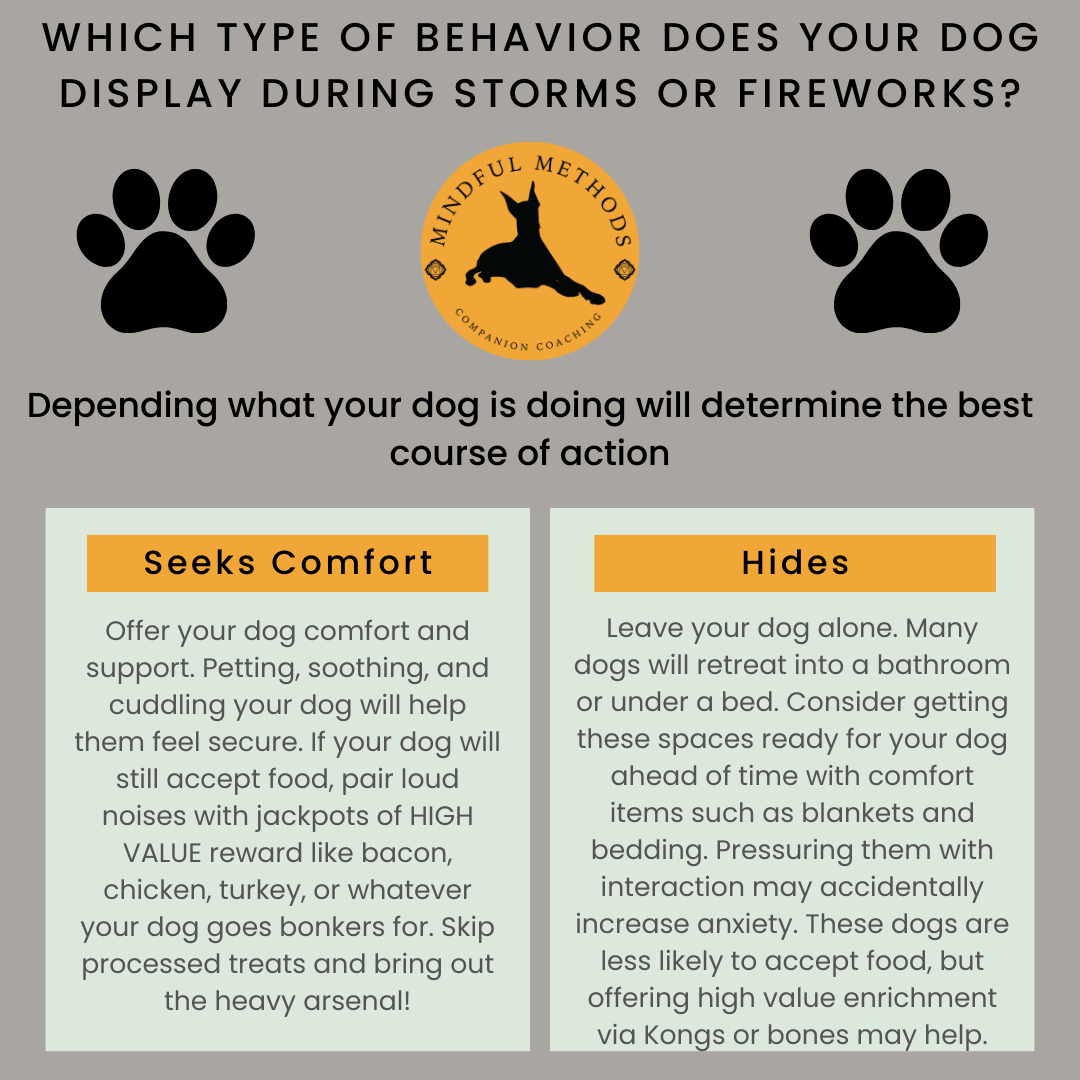
Uh oh - are you in the thick of things and unsure how to comfort your dog? What you should do will depend entirely on what your dog is doing.
For dogs that seek comfort during storms - please offer it!
Things like petting, soothing, and cuddling with your dog may help to reassure them.
Offering them some comfort items is a good idea! If your dog likes to be under a blanket with you, this might make them feel secure.
Other things may include offering high-value enrichment items such as frozen Kongs or meaty bones to keep their mind off the storm.
Some dogs may not accept food depending on the severity of the storm. If they will, try some easy counter conditioning exercises with HIGH VALUE food items such as bacon, chicken, turkey, or whatever else your dog goes CRAZY for! Skip the processed treats and go straight to the big guns!
Every time you hear a BOOM - make it RAIN down treats for them. This may help to cut down on fearful responses and instead get them looking forward to those noises because it always means a jackpot of treats! Be liberal with your rewards and use something SUPER YUMMY!
For dogs that hide - please leave them be!
This one is super tough because instinctually we want to provide comfort and try and soothe our fearful companions. For dogs that run and hide under beds or into bathrooms, they are trying to tell us they need to be alone to cope.
The best thing you can do is give them space. Pressuring interaction, touching, or speaking to a dog during this time may increase anxiety by accident.
If you know your dog does this, consider getting those areas set up beforehand with comfort items such as bedding and blankets so they can hunker down and feel safe and warm.
If your dog seeks their crate, covering it with a heavy blanket may help reduce some of the noise and help them feel more secure.
These dogs are less likely to accept food during storms, but leaving frozen Kongs or meaty bones in the area may help if they feel safe enough to work on something. This will keep their mind off the sounds and also pair the sounds with positivity.
How to Prepare Your Dog For a Storm or Fireworks in the Future

Natural remedies can be a great thing to explore if your dog’s fear is on the mild side. For dogs with phobias, other routes will be discussed later in the blog.
Natural calming remedies can be hit or miss and usually require some tinkering to find the best possible option for your dog. The products discussed below may contain affiliate links which are subject to commission at no additional cost to you. Below are some of our faves!
As with any product that your dog uses or ingests, we recommend consulting your veterinarian first.
Pheromone products or essential oils
Adaptil calming products (recently bought out by ThunderEase) has some excellent pheromone products such as sprays, plugins, and collars in small, medium/large, and puppy sizes that might work well. I am a personal fan of the collars.
Rescue Remedy is a food or water additive that uses flower essence to provide a calming effect.
Composure Chews uses several different herbs and vitamin extracts to help produce a calming effect.
Zylkene is Bovine Hydrolyzed Milk Protein that may produce a calming effect. This one is typically given daily and has a loading period - meaning it may take several weeks to take full effect. This can be a great option for dogs or cats that might be a little stressed about other things in daily life, too. This comes in doses for small or large pets.
Calming essential oils such as lavender, coconut, and vanilla have been shown in studies to reduce signs of stress including pacing, whining, and vocalizing. Always research the safety of essential oils before applying them to your pet’s items or diffusing them in your home as many of them may be deadly to different species.
Calming music and Thunder Shirts
These we want to be very careful with that they are positively conditioned BEFORE we actually need them as it is extremely easy to “poison” these methods with fear.
Applying them only when something extremely stressful is about to happen may create a “trigger to a trigger” scenario and your dog may begin to predict that a storm or fireworks is incoming. Just like a leash may signal to your dog that you’re going for a walk and elicit excitement, the sight or sound of these items may accidentally elicit fear/fleeing if not done correctly.
I always recommend working with a qualified, positive reinforcement, behavior modification professional before introducing these. I personally like associating these things with calming activities and high-value food reward.
Calming piano music - avoid crashing percussions and opt for solo piano or calming classical music. Reggae also works, if you prefer. This has been studied across multiple species and can have calming effects on brain waves as well as drowning out some of the sounds of scary noises.
Thunder Shirts - for dogs that like pressure on their body (sleeping under blankets, snuggling) they may find calming effects just from the compression. However, it is still recommended to condition the item to increase positive emotional responses. We generally do not regard this item as a magical fix all by itself. For dogs that dislike clothing or being handled, it may have the opposite intended outcome.
How to condition music or Thunder Shirts with positivity:
Feed your dog meals while the items are on
Give your dog enrichment while the items are on
Train your dog/give them yummy treats while the items are on
Apply the items while “nothing” in particular is happening and they’re going about their day
Allow them to sleep while the items are in use so they associate them with relaxation
Play fun games with your dog while the items are on
A full list of calming products that I love and recommend (and a BUNCH more) can be found on our must-haves list.
Other Considerations to Help Dogs with Noise Sensitivity
Rule out medical issues
This topic is currently under-studied and commonly misunderstood between a variety of professionals. In the behavior community, there is a growing body of evidence and acceptance that many behavior issues are linked to medical problems - especially those that cause pain or discomfort.
Particularly when it comes to noise aversion, there are STRONG links to underlying pain components causing these responses or making them worse. I have a link library filled with studies, but you can visit this one on pain and behavior for more info.
I always try to impress upon clients and other professionals that I network with the following logic:
Think about how YOU feel when you are in pain or are sick. Is your frustration tolerance as good as it usually is? Do you get upset more easily than you normally might?
What is the first thing you do when you are scared or nervous? Your muscles will likely tense and you’re more likely to move more quickly, unnaturally, or repetitively (like pacing your house). Dogs do the same thing! These behaviors and movements can exacerbate pain - especially if a dog is also trembling.
Dogs can accidentally associate the trigger with the increase in pain, not realizing that it’s their own behaviors that are contributing to the issue. (This is where training comes in to teach the dog better coping skills)
Lessons learned while experiencing pain are often learned differently and more quickly/intensely. Pain pushes the brain into a fight/flight response as a means to avoid that outcome again in the future. These responses are instinctual, automatic, and lack any real logic or reasoning as they’re meant for survival (no matter how unreasonable it may seem to us). These are harder to modify and overcome, especially with animals that we cannot easily reason with verbally.
Dogs experiencing pain will have a more difficult time learning if their brain is expending energy dealing with these issues. Just like in humans, pain can increase fatigue and contribute to memory retention issues when the brain is prioritizing survival.
The Canine Arthritis Management Institute states that 35% of dogs over the age of 1 already have arthritis. It is a young dog’s disease. That number jumps to 80% by the age of 8-years-old. That, all by itself, is staggering.
When I am dealing with cases with extreme fear/phobia, aggression, and anxiety I always recommend ruling out medical issues through a variety of tests. You can read more about that in my prior blog on pain and behavior, as we aren’t going to dwell on it in-depth today.
Suffice it to say if the behavior is sudden or suddenly worsening, a trip to the vet may be recommended!
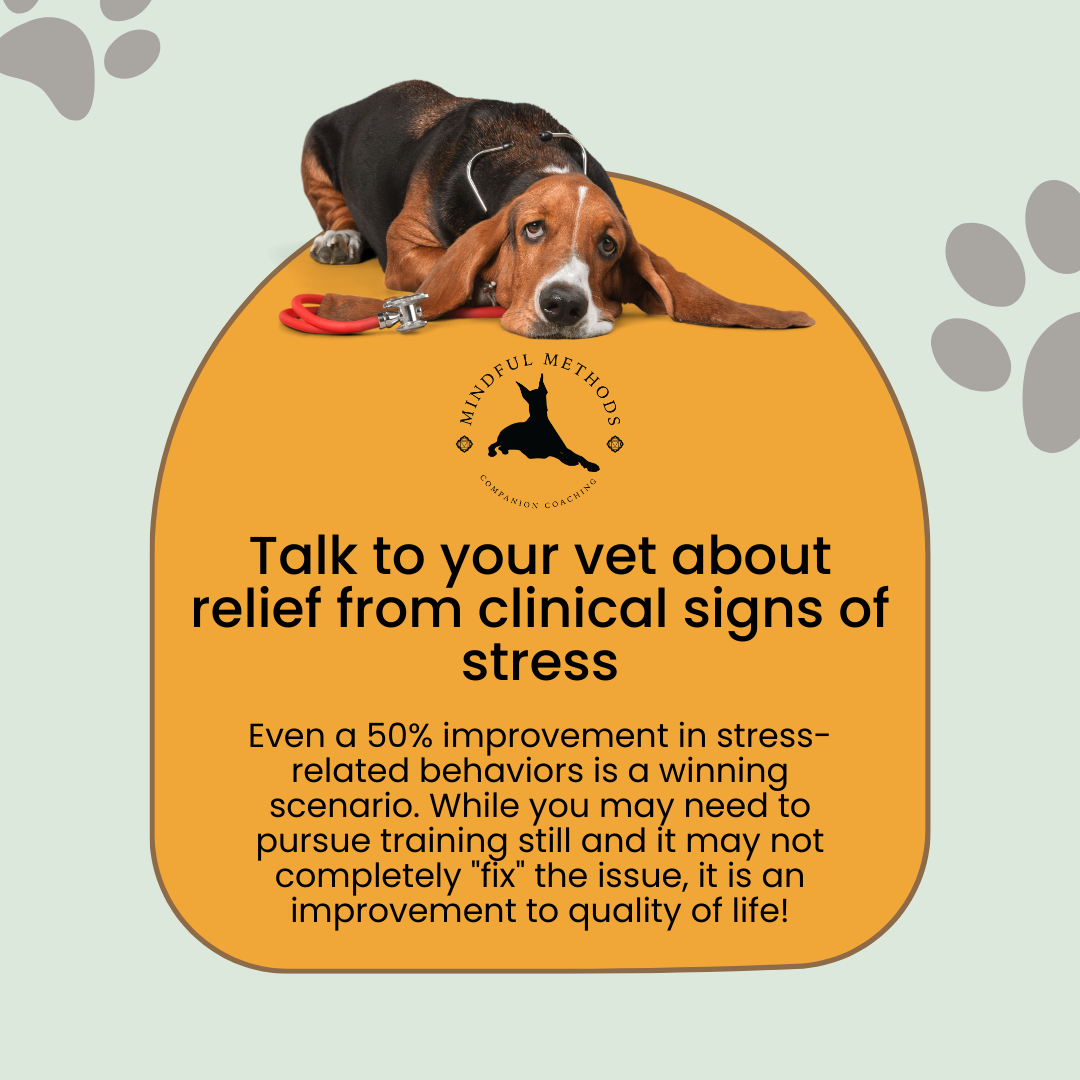
Talk to your vet about relief from clinical signs of stress
Certain things about storms and fireworks such as the sudden and unpredictable nature of the events and the sheer volume of the trigger lends itself to a situation that is ripe for anxiety and hypervigilance. These things can also feel harder to control on the human side of the equation.
For storms in particular, atmospheric pressure can also upset animals and sometimes for prolonged periods before or after the event. That is an element that we truly have no control over and can contribute greatly to an animal’s response.
For dogs that are extremely fearful, shutdown, or outright phobic of loud noises like storms or fireworks, it may be past the point where natural remedies should be considered as a first option. Especially if you’ve tried several remedies already with no real effect, then I encourage you to elevate it with your primary vet or a vet behaviorist.
There is a common misconception that intervention with medication will fix the issue entirely. It might - but it might not either. In behavior modification, we always stress progress over perfection in the beginning. Even a 50% reduction in fearful behaviors is a winning scenario for that animal.
Extreme fear that immobilizes is a quality of life issue and if you live in an area where storms are frequent, this can be a weekly occurrence for a lot of our pets.
Should a qualified professional deem this necessary, this could further open the door for behavior modification training to take place once the animal isn’t so stressed and can focus. At this point, we hope to introduce counter conditioning and have it be more successful.
Training and medication always compliment each other and go hand-in-hand - just like humans see the most progress in coping with their emotional issues when they also seek therapy, this is how we can view the relationship between formal intervention and training.
We need participation in the process in order to teach an animal how to cope. If they are hiding or won’t accept food, we do not have an animal that is capable of learning just yet. Intervention can be life-changing for everyone involved.
Again, I encourage you not to wait and see if it gets better. Consider reaching out for help before it gets any worse instead.
Written by: Jessie Kasper IAABC-ADT, FDM, FFCP, PNCC
Mindful Methods Companion Coaching