
Littermate Syndrome

What is littermate syndrome and is it real?
I am frequently asked from clients considering getting a puppy whether or not they should get two puppies and if “littermate syndrome” actually exists. This is a loaded question with a complicated and nuanced answer.
Littermate syndrome as a pathological diagnosis is not actually recognized by the veterinary community, particularly as it pertains to Veterinary Behaviorists. If you’re unfamiliar with the Vet Behavior specialty, you can find more info via the American College of Veterinary Behaviorists.
Abundantly, the issue seems to be surrounding semantics. There is plenty of anecdotal evidence amongst trainers and other professionals to build a case that something unique behaviorally may happen when two companions from the same litter or of a similar age are brought into the home at/around the same time.

The term “littermate syndrome” tends to be too broad as within that term can exist a myriad of recognized behaviors and clinical diagnoses such as Generalized Anxiety Disorder, Separation Anxiety, Fear Aggression, Conflict Aggression, Resource Guarding, and many more.
Even those terms have their own struggles with broad definitions, but the treatment and intervention for each of those diagnoses can be different and incredibly important.
So, what do we call it then? Great question. I don’t have an answer for that, honestly. As much as I wish I had all the answers to everything behavior-related, I simply do not. For the ease and purpose of conveying information in this blog piece, I am going to call it “littermate syndrome” with the understanding and acceptance that as a diagnosis, doesn’t actually exist.
What I can cover is what may happen when two companions from the same litter or similar age are brought into the home at/around the same time. This is not always guaranteed to happen and can largely depend on the human portion of the equation and how much time and energy is spent on proper socialization during puppyhood, adolescence, and beyond.
Important note: we can see these same behavioral representations in dogs that are not necessarily littermates but are roughly the same age and brought into the home at roughly the same time, too.

How dogs learn to communicate and avoid conflict
Theories are abundant in behavior. What is scientifically understood about hierarchies in dogs is that dominance can ebb and flow depending on the situation and including factors such as size, age, length of residence, social rank in the house, and what each individual dog may prioritize or place value on.
For instance, one dog may place a higher importance on dog beds and resting spaces and the other dog in the household doesn’t really care and so yields to the other dog in this instance. The yielding dog may place a heightened value on a specific toy that the other doesn’t care about and so we get a beautiful and fluid conversation between two individual dogs that is rooted in mutual respect.
When there is “conflict” between two dogs, it is typically handled through a process called “ritualized aggression”, which simply means natural and instinctual social cues like stiffening of the body, ears back, giving a side eye, and certainly escalations like growling, lunging, barking, and baring teeth. Ritualized aggression is the precursor to actual aggression and is actually meant to avoid and diffuse actual aggression.
Actual aggression is an extremely “costly” behavior mentally and physically. Believe it or not, dogs don’t typically want to resort or default to biting/fighting. They’d much prefer to avoid the calculated risk of physical injury.
Dogs that have a healthy relationship will respond well to lower-level social cues and we may never see an escalation into actual aggression. Dogs also learn proper playstyles and how to accurately read the social cues of older dogs during play, learning when to back off or stop.

Puppies learn how to communicate with their conspecifics through these rituals and take in a lot of life lessons from older companions in the home about what is and is not appropriate. Puppies encounter steep learning curves in home environments and are generally very poor at reading body language when they’re extremely young.
This presents unique challenges for integrating puppies into households - particularly due to decreased space in the home. Think about it – our dogs basically live a captive lifestyle nowadays. They definitely are not domesticated.
Domesticated dogs still had a lot of autonomy to make choices, had a lot of space to roam, and were enriched individually based on their own breed-specific preferences. Dogs living on a farm and working all day don’t have as much time to fight each other and most importantly - have A LOT of room to make space for themselves and take a deep breath when they’ve hit their tolerance threshold.
How does “littermate syndrome” happen?
Bonded pairs are often heavily reliant on each other seeing as their energy levels and playstyles will be quite similar in the beginning. Many young dogs have no concept of an “off button” and will play hard for long periods of time, if allowed to. Since both of these dogs are not actively learning appropriate social cues from older, more savvy dogs, proper socialization can take a massive hit. Neither dog may properly learn how to turn off their energy and relax and if they do, are often sleeping together and in each other’s space constantly.
Thinking back to learning proper social cues, appropriate energy levels, and reading body language, as these two dogs age, neither may have learned how to read those cues OR issue those cues. So, we may see heightened displays of ritualized aggression leading into actual aggression, which results in fighting with one another, other housemates, or strange dogs that they encounter.
Furthermore, as these dogs mature and develop, individual needs and desires emerge and many guardians treat bonded pairs as a unit instead of as an individual – and individuality and having needs met is just as important to our companions as it is to us!
When dogs are treated as a unit instead of as an individual, this often results in these dogs not getting enough space from each other, period.

They often share everything – food bowls, walks, attention from their guardians, vet visits, car rides – nothing is sacred or theirs. This can place heightened value on everyday things that other dogs may not struggle to share when asked to.
Because these dogs are essentially “equals”, unhealthy competition for resources can arise, leading to resource guarding. Resources are anything a dog places value on such as food, toys, resting spots, crates, and even people. Some trainers would tell you that people cannot be a resource but I feel that is categorically incorrect since a resource is anything that aids in the survival of an animal and provides comfort and stability.
We humans are a massive part of stability, comfort, and routine and the place in which almost every other resource is obtained. We decide when and what they eat, when and how they exercise, when and where they sleep, when they get medical care, and when and how they are enriched.
Thus, a huge side effect of “littermate syndrome” that I hear about is the guarding of the primary caregiver in the home.
Another troubling aspect of sharing every life experience together is that we often hear about Separation Anxiety emerging for an over-reliance on each other, as well. These dogs can be frantic, pacing, and anxious when the other dog is removed from the environment.
How do I stop “littermate syndrome” from occurring?
Well, the answer is: resist the urge to bring home dogs from the same litter or dogs very close in age, around the same time.
One puppy is quite enough work to manage! What often ends up happening with even one puppy is humans go into “survival mode” during tough growth periods and find themselves living day-to-day and just trying to get by.
Two puppies can increase fatigue and the humans begin relying on the puppies to keep each other company, teach each other lessons, and provide all sources of play and enrichment. Proper socialization can fall by the wayside very easily.
But let’s say you’ve already done it, then what? How can we lessen the chances that behavior issues will pop up in the future?
Hire a trainer committed to positive and humane methods to help you understand what proper socialization is and is not. There are a lot of misconceptions about this for pups!
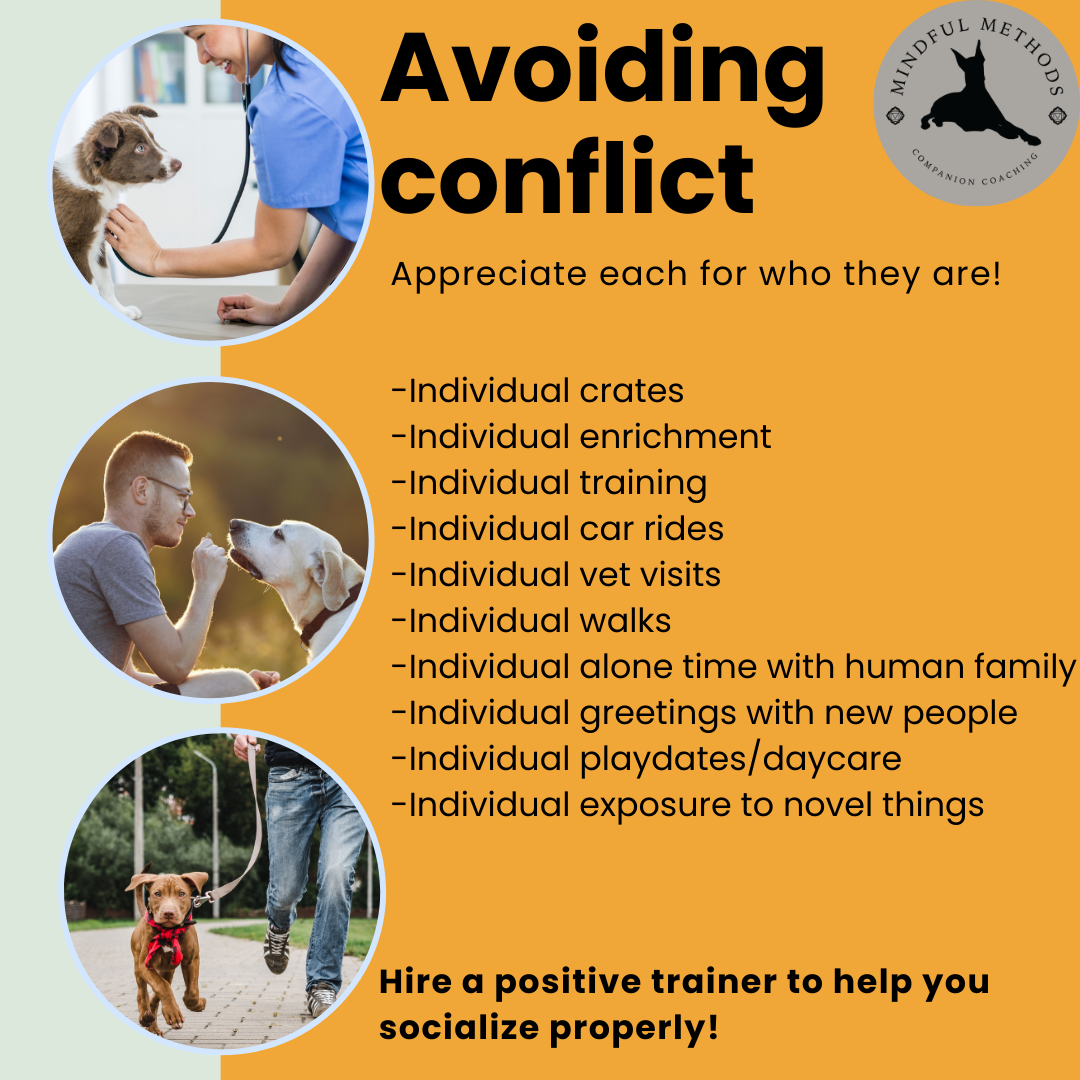
Treat them as individuals and strive for a conscious effort to appreciate each for who they are! This means:
Individual crates and purposeful downtime away from each other to work on enrichment that each finds individually pleasing.
Individual training.
Individual car rides.
Individual vet visits.
Individual walks.
Individual alone time with each human family member. Each person should also rotate caregiving roles!
Individual greetings with new people.
Individual play dates/daycare to socialize with dogs outside of the household.
Individual exposure to triggers and new environments so they can form their own opinions and feelings without influencing each other.
If this sounds exhausting and like double the amount of work, it’s because that’s exactly what it is.
The caveat with all behavior though, is that sometimes we do everything “right” and things still turn out differently than we hoped. There are no guarantees in life when dealing with the emotions and learning of creatures capable of independent thought.
What should I do if “littermate syndrome” is occurring?
If you’re here because you’re already experiencing behavior issues, here are your options moving forward:
If the behavior is severe and/or sudden, ensure that nothing medically is influencing it. Reach out to your primary provider to rule out medical causes.
Hire a trainer committed to positive and humane methods to help you modify the behavior and establish trust again.
Consider working with a board-certified Veterinary Behaviorist. If the relationship has been deteriorating, additional interventions can speed along the process and ensure that your time and resources are used to the fullest when spending time training and counter-conditioning.
Addressing behavior issues does not have a one-size-fits-all approach. Successful behavior modification usually functions on addressing physical health, emotional health, employing proper training, and using better management going forward.
Oftentimes, all of these things are recommended at once so that you have a team of professionals behind you, with the same interests in helping you achieve your goals.

The more extreme outcomes of “littermate syndrome”
These are always the toughest conversations to have with clients and to be clear, these next options are never ethically a trainer’s place to recommend to you. These are incredibly personal choices that people sometimes have to make when safety and liability are untenable and/or all other options have been exhausted.
Re-homing a companion is often a last resort for people and is a very serious consideration that does not come easily. Sometimes though, the behavior between companions is so severe, that people may have to decide that for the safety and well-being of the household, one of them has to leave in order to live a more fulfilled life. There is nothing wrong with needing to do this and sometimes it is the best possible option for that family. It is your legal and ethical responsibility to disclose the issues to a new home or rescue so that they can make sound placement choices and avoid harm in a new household. This may make rehoming a companion more difficult.
Behavioral euthanasia may be a decided outcome for that family and is little talked about in the behavior world. Many people do not even realize that it is an option. I am not suggesting that this is a first line of defense or even personally recommending this. This is an INCREDIBLY personal choice for each family to arrive at. Usually, this comes about when the companion’s behaviors are so severe that it is determined that they cannot be rehomed and/or are not safe anywhere else. Decisions like this are extremely hard but usually, there are grave safety concerns within the home and with quality of life for all parties. Below are some resources regarding that:
Moral of the story: do not wait if you are experiencing issues between bonded pairs.
Preemptive measures can make or break outcomes and getting in front of the behavior issues before they become a well-rehearsed, established habit of communicating is the key to receiving the best prognosis.
Written by: Jessie Kasper IAABC-ADT, FDM, FFCP, PNCC
Mindful Methods Companion Coaching
info@mindfulmethodstraining.com