
Should I send my dog to doggy daycare?

This month I’m covering a topic I get asked about all the time by clients, and that is: “should I send my dog to doggy daycare?”
Spoiler alert: I’m not a HUGE fan of doggy daycare, nor dog parks. Both of these environments I refer to as “highly unstructured” and place on similar levels with each other.
I also can’t lie, the mauling leading to the death of a small breed dog by a large breed dog at a local doggy daycare facility is what prompted this blog, initially. These stories are pretty common, sadly.
Aside from a few exceptions where doggy daycare might be a safer option (like self-injurious separation anxiety behaviors), I generally find them to be an unnecessary risk physically, behaviorally, and socially - all of which I’ll break down for you today.
I’ll also get into what types of questions to ask providers and red flags to look for when choosing a provider. To be sure, there are some well-structured and well-done doggy daycare providers out there, but finding them is incredibly difficult. I think it’s harder to find a good doggy daycare than it is to find a good dog trainer, unfortunately.
In order to understand why doggy daycares aren’t my jam, I think it’s important to discuss what we know about how dogs spend their time through some studies that have been done.
So, let’s get after it from an ethological standpoint, first!
The Canine Ethogram - What Comes Naturally to Dogs?
In a course I’ve taken, the Aggression in Dogs for Professionals with Dr. Amber Batson, we learned about several studies that were done on street dogs. They are the closest examples we currently have to truly “wild” Canis familiaris (domestic dogs).
Researchers set out to answer the question of what dogs REALLY want to do when given full autonomy and choice, and so there is some interesting data available on their habits when left entirely to their own devices.
Ethogram of Behavior in Street Dogs
In 2014, a study was done in India on street dogs where they were observed over the course of many days to figure out how they budget their time. There were some limitations in the data, such as only being able to observe them for 16 hours per day. This was due to safety concerns (other large predators) and being too dark overnight for the researchers to collect data. (Majumder et al., 2014)
Here is what they found:
54% of the time they were inactive - resting or sleeping. This correlates with multiple other studies on dogs and may even be higher had the researchers been able to observe overnight.
27% of the time was spent doing whatever individual behaviors they wanted to do - about half of that was spent walking around and the remaining half was spent inspecting the environment through sniffing (most frequent), watching, or listening as well as engaging in trotting or running. Dogs weren’t necessarily solitary during this time. There were likely to be other dogs and humans around that they weren’t directly engaged with.
10% of the time was spent being directly affiliative - dog-dog interactions such as playing together and grooming each other; human-dog interactions such as begging for food, wagging their tail, following, receiving food, etc.
6% of the time was spent doing maintenance behaviors like eating, drinking, chewing on things, self-grooming, going out to scavenge for food, and urinating/defecating.
3% of the time was spent vocalizing - barking, howling, and growling (least recorded vocalization). Aggressive behaviors (moving towards a target and attacking) were non-existent in this particular study, which isn’t unusual in street dogs.
In most street dog studies, aggressive behaviors are extremely limited when they have the option to remove themselves from conflict. Fully engaging in a fight is an extremely calculated measure for a “wild” dog, as losing a fight can have dire consequences to survival and/or reproduction.
Some simplified takeaways:
Over 50% of the day was spent being inactive.
48% of active time was spent walking. Chasing a potential prey was only seen twice. Researchers did not actually witness any dogs killing another animal so the intent of the chase is unknown.
Just under 50% of the remaining active time was spent directly interacting with others. 85% of those interactions were with other dogs.
Being in the presence of others did not always mean they were directly interacting.
Behavioral concerns with doggy daycare
After reviewing those basic statistics above, its easy to see how doggy daycare might not be a good option for certain dogs. The biggest concern is that daycare is often an overstimulating environment. Dogs are on the go, sometimes all day long - when naturally, they are likely to spend most of their day inactive/resting/sleeping while the sun is up. Additionally, they don’t spend a whole lot of time directly interacting with other dogs. In summation, doggy daycare environments are pretty unnatural environments, behaviorally speaking.
Here are some of the potential fallout I have seen behaviorally, in my cases:
Dogs never learn an “off switch” and become “athletes” for repetitive, high-intensity behaviors
Dogs learn to play too rough, for too long with other dogs
Lack of rest and decompression can cause grumpiness/moodiness at home - especially if a dog has an underlying/undiscovered medical condition
Dogs on the receiving end of bullying or inappropriate play may develop reactivity on or off leash
Dogs that grow up getting to meet/play with every dog they encounter never learn neutrality in public settings and can develop frustration on leash or reactivity.
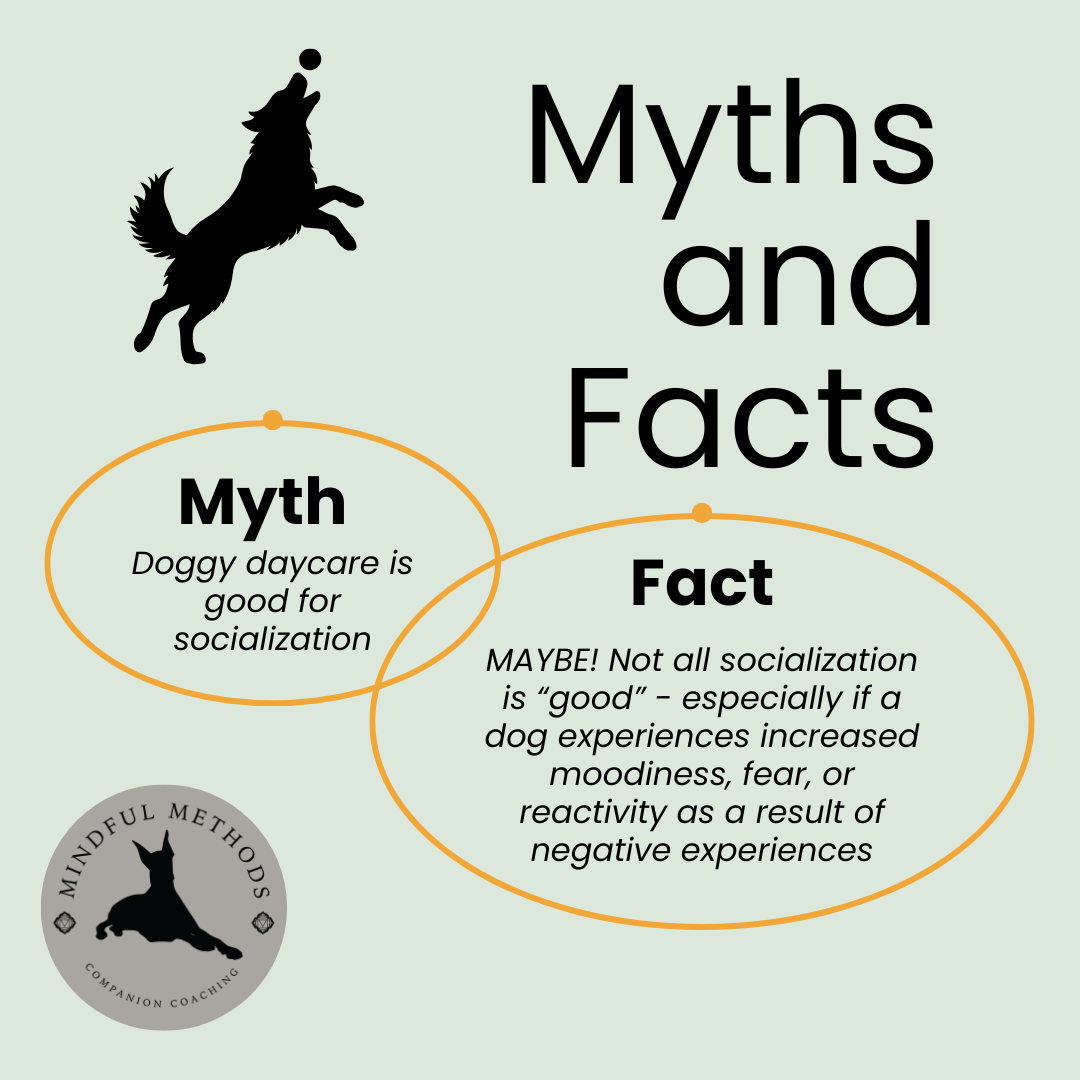
The biggest pervasive myth with daycare is that it is good for socialization. Not all forms of socialization are “good” socialization if there is heightened risk of behavioral fallout.
At best, that’s a big ol’ MAYBE - and that depends entirely on the structure and protocols of the daycare you choose, as well as the temperament of your individual dog! We often anthropomorphize socialization with dogs and project our human needs and feelings onto them.
I don’t mean to be negative, but I do want to give you ALL of the possible considerations as to whether or not a doggy daycare is right for your particular dog. As stated prior, this might be really ideal for dogs with separation anxiety. Some dogs may even need a healthy outlet for play because the other dog in the home is elderly and getting annoyed. But - if your dog is already fearful of others dogs and humans, this type of experience could be TOO stressful for them at the moment.
If you determine daycare is the route to go - TAKE IT SLOW. Start with 1-2 days per week, if possible, and pay close attention to their behavior at home before adding additional days.
So, let’s get down to discussing what to look for!
Questions to ask doggy daycares
I know when people call me and have questions prepared that they have done their homework and will be excellent clients. A good doggy daycare will be patient and happy to answer all of your questions and discuss their business. In fact, their reaction to your questions is the first test!
Below is a list of open-ended questions to ask doggy daycare providers, without any information that might lead them to the answer you are looking for. Listen carefully to answers and pay attention to inconsistencies:
ASK FOR A FULL TOUR OF THE ENTIRE FACILITY AND THE PLAY YARDS! (do a visual inspection for safety concerns, especially fencing)
Are they licensed and do they have insurance? (ask for proof, especially small, in-home doggy daycares)
Do they have a service contract? (ask to see it ASAP and read it thoroughly before signing)
How are dogs evaluated?
How are new dogs introduced into the playgroups?
What are the size of the playgroups? (look for SMALL playgroups of 3-5 dogs at a time)
Are dogs separated by size, age/energy, and playstyle? (avoid doggy daycares that mix large and small breeds together)
What is the employee-dog ratio? (I like to see 1 handler for every 2-3 dogs)
Are dogs ever left unsupervised?
Is there a certified trainer or behavior consultant on staff? If so, what formal certifications do they have and what methods do they use? (anything other than a positive reinforcement-based trainer is a red flag)
How are the staff trained? What certifications or courses are owners/staff required to have as it pertains to body language and basic behavior?
Who are the staff? How much experience does each one have in this type of environment?
How do they prevent altercations/bullying/rough play?
How do they stop altercations/bullying/rough play and what tools do they use to intervene?
What management and/or training tools are used, if any?
What other types of enrichment can they offer if a dog is having an “off” day or doesn’t want to interact?
What is the structure of the day?
Where, when/how often are they offered potty breaks?
Are rest periods built into the day automatically? If not, can you opt into them? (you should opt into them)
When/if rest is provided, do they have a separate room? Do they crate, kennel, or use suites for the resting dogs? (this is ideal to ensure proper decompression)
Are there resting stations in the play areas, if a dog needs a short break? (like cots)
Do they have cameras? Can you view them remotely? (at the very least, cameras on the dogs are helpful if there is an incident, whether or not they allow remote viewing daily)
Do they provide daily reports, pictures, or videos about what your dog did or the type of day they had? (ideal to track behavior issues)
How often do they clean and what products do they use? (visually it should look clean and not have any strong/offensive odors)
What is their vetting policy for vaccinations, spay/neuter, and other general health concerns like worms, skin issues, etc.?
What is their reporting protocol for potentially contagious diseases?
Do they have fresh air intake systems in any kenneled/suite areas?
Do they allow dogs with aggression issues towards dogs or humans?
Do they feed any of the dogs during the day and where does that happen? (dogs should be fed away from all other dogs)
Are dogs given access to water, how often, where are the bowls located, and how many of them are there? (there should be lots of bowls around and constant access to water)
Do they use breakaway collars or do the dogs play “naked”? (leaving on flat collars is a safety/strangulation risk)
What type of flooring do they have? (seek a facility with non-slip, shock-absorbing/rubber flooring to avoid slips, falls, and injuries)
How do they move dogs around? What is the safety protocol for hallways and exits? Gates? (these are hot spots for potential conflict and flight risks)
What is the policy/process of reporting injuries or altercations?
What veterinary provider do they use, if there is an emergency? (double check their hours)
Will dogs ever be walked and how often?
Will they be transported and does the vehicle have the proper climate-control features? How do they secure the dogs in the vehicle? (asking to see insurance and touring the vehicle for safety measures is recommended)
How often are play yards inspected for safety? (e.g. fencing)
So, that’s what I got for ya this time! There ARE several daycares in the Chicagoland area that we can recommend. There are even MORE day training programs that we recommend instead, to ensure proper structure and enrichment, all while providing learning opportunities with certified trainers. Reach out to us and we will point you in the right direction!
Written by: Jessie Kasper CDBC, FDM, FFCP, PNCC, CAM Advocate Level 1
Mindful Methods Companion Coaching
info@mindfulmethodstraining.com