
Training Expectations
Train the companion you have, not the companion you want!
Fast facts:
Animal behavior changes depending on circumstance and environment and is further affected by breed traits, prior training history, and any genetic cognitive issues inherited through breeding.
Training is required for the entirety of your companion’s life – especially during the two fear periods and as your companion reaches social maturity.
Beware of any training programs that claim to “fix” or “cure” issues. There are no guarantees when dealing with the behavior of another living being.
A single session, class, or even a package with any training program WILL NOT be able to achieve advanced skillsets. Follow-up sessions/packages will be necessary in most cases.
It is crucial that we meet our companions where they are at now, socially and behaviorally. It is important to remember what the companion in front of you is both physically and mentally capable of. Always research the breed you have before deciding what may or may not be possible for your companion in terms of socialization and training goals. The skills of our companions depend more on their abilities versus our expectations.
Practice makes perfect – even for undesirable behaviors. Meeting and exceeding training goals takes patience and PRACTICE. If we are attempting to create new habits, first think about how long it took for your companion to get to this point behaviorally and be prepared to work hard to overcome those undesirable habits.
Expectation versus reality:
With training, it is important to remember that animal behavior is never fixed or static. It changes depending on circumstance and environment. Even trained behaviors will fade or extinguish over time without consistent repetition and practice. Although behavior may be modified, the dog is never “cured” - especially in cases of fear or aggression. A companion’s behavior and success with training will require follow-through for the rest of that companion’s life - and it falls upon the guardian to ensure continued learning! Dogs are sentient creatures and many factors go into the decisions our companions will and won’t make – such as breed traits, prior training history, or any genetic cognitive issues inherited through breeding. It is crucial that we meet our companions where they are now, socially and behaviorally. It is important to remember what the companion in front of you is both physically and mentally capable of. Always research the breed you have before deciding what may or may not be in their behavioral repertoire and how easy socialization will be. The skills of our companions depend more on their abilities versus our expectations. Set you and your companion up for success by having realistic expectations!
Beware of any training programs that claim to “fix” or “cure” issues. There are no guarantees when dealing with the behavior of another living being. We see these types of troubling over-promises from traditional/balanced trainers and board and train businesses the most. There is a common misconception that board and train programs can accomplish high-level training goals in 10 days, when the truth is that your companion will most assuredly need continued training to accomplish more complicated behavior goals. You may even need to re-engage in training as your companion matures and experiences temperament shifts. Dogs go through two major fear periods in their lives – once at 8-11 weeks old and the next between 6-9 months old, with social maturity setting in around 18 months old. During these periods, increased efforts to continue training and socializing are necessary to ensure your companion stays balanced as they grow.
This is easier to understand when we break down behavior skills into “schooling” levels, like humans experience. Collectively, we attend school for a quarter of our lives, at a minimum - and for most of the year! We would be significantly delayed in crucial life skills by the time we reached maturity if we only took one class per year, once a week – which is more than most companions are provided.
Meeting and exceeding training goals takes patience and PRACTICE. If we are attempting to create new habits, first think about how long it took your dog to get to this point behaviorally and be prepared to work hard to overcome those undesirable habits.
One of the biggest things to consider during training is the environment you are attempting to train in:
Outside environments can be overwhelming, especially for adolescent dogs or rescue dogs trying to acclimate. With so many things to process, trying to process your voice can be a challenge.
Once dogs are fully fluent and able to perform behaviors with 100% accuracy indoors (no distractions) then we can move to adding distractions indoors. All of this needs to be accomplished and perfected before we can consider training outdoors with low distractions.
Here is a graph of what to expect at different levels of training with your companion:
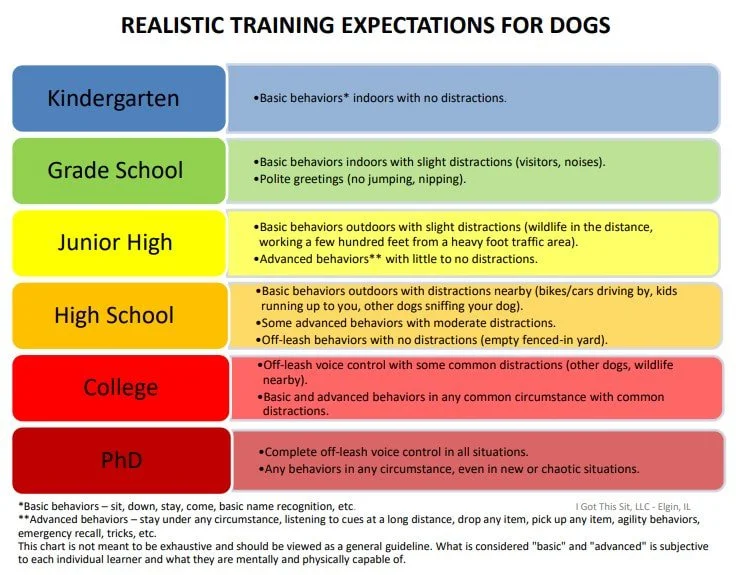
Some skills can reach college/Ph.D. levels while some skills may never advance past grade school or junior high school levels. Remember that what is easy and what is hard is subjective to each individual learner. For example, some humans can do trigonometry and some humans can barely do algebra - our companions also have varying levels of intelligence! Recognizing the individual strengths of your companion is the first step to building a better relationship. It is important to exercise patience with training and practice with your companion often. My program can help you get started on creating and solidifying the foundation behaviors needed to build more advanced skills.
Practice makes perfect!
Contact me today to get started on your learning list!